

Beveled-Head Cannulated Buttress Screw System
- Foot & Ankle Implants
- Screws
- Composite Product
- Cannulated
- Buttress
Specification
- Material
- Titanium Alloy
- Diameter
- 2.5 - 4 mm
- Length
- 10 - 70 mm
In this system
System components
Overview
Kangli Orthopaedics manufactures this titanium alloy beveled-head cannulated buttress screw system for foot and ankle fixation procedures. Its central cannulation accommodates guided insertion over a guide pin, while the enlarged beveled head provides a defined buttress surface at the entry side. Threads extend along most of the shaft to provide a long threaded engagement zone within the selected fixation path. Screws are offered in 2.5 mm, 3.0 mm, 3.5 mm and 4.0 mm diameters across a range of lengths.
Cannulated Design for Guided Screw Placement
A central passage extends through the screw along its longitudinal axis. This configuration accommodates a guidewire-based insertion sequence and helps maintain the selected trajectory as the screw advances: the guide pin defines the path first, and the screw follows it rather than establishing its own direction. The cannulated shaft is suited to workflows that call for guided alignment during placement.
Percutaneous Insertion With an External Aiming Device
The guide pin can be introduced through an external parallel aiming device, so the entry point and angle are set outside the body before anything advances into bone. Because the screw then travels over that pin, the aiming device carries the trajectory through to the implant, and the placement can be completed percutaneously without opening a working window to sight the path by eye. Trajectory decisions move from the screw to the aiming frame, which removes the freehand alignment step at insertion.
Enlarged Beveled Head for Buttress Seating
The enlarged head transitions into the shaft through a rounded, beveled profile. This geometry presents a broad seating surface at the near side of the fixation and creates a defined stop at the entry region, so the head bears against a wider area than a smaller terminal head presents. The design distinguishes the implant from screws that rely on a compact head form.
Extended Threading Along the Shaft
External helical threads run from near the head toward the tapered distal end, covering most of the cylindrical shaft. This near-continuous threaded profile puts more thread in contact with bone along the path, providing an extended area of engagement when the selected fixation technique calls for threading beyond a short distal section.
Tapered Distal Tip for Directional Entry
The distal end narrows into an angled, pointed tip, followed by a cylindrical threaded shaft. The tapered lead introduces the implant into the prepared path before the threaded body advances along the established direction.
Foot and Ankle Fixation Applications
The system may be selected for:
- buttress screw fixation in the foot
- buttress screw fixation in the ankle
- cannulated screw placement along a guided trajectory
- percutaneous placement using an external parallel aiming device
- fixation techniques requiring an enlarged beveled seating head
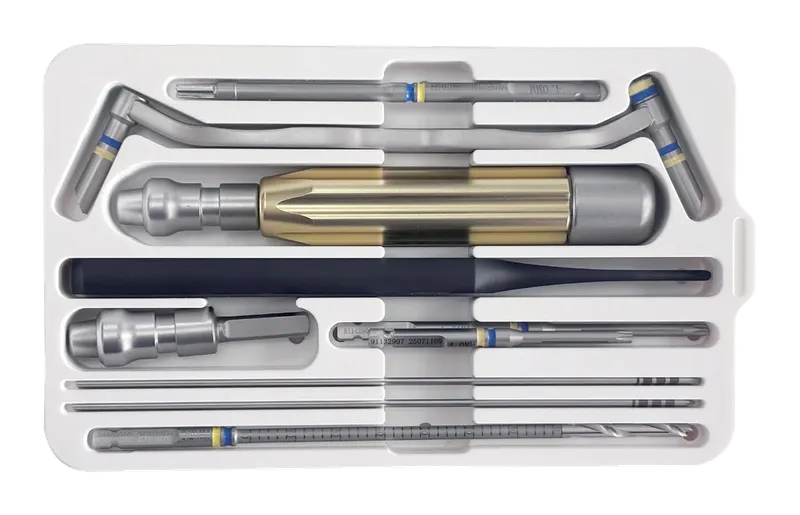
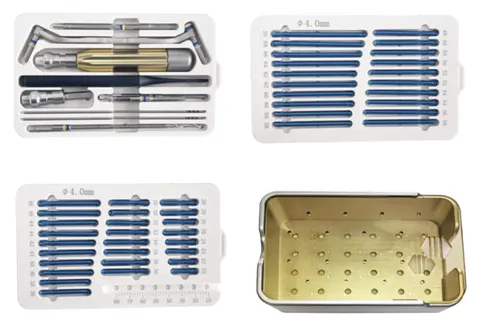
For cases requiring a different screw configuration, distributors and physicians can review this system alongside the Cannulated Headless Compression Screw with Double-Ended Threads for foot and ankle applications. The matching Beveled-Head Screw Instrument Set covers the instrumentation side of the workflow.
Related