


Cannulated Compression Screws

Overview
Range overview
Cannulated compression screws account for most of this sub-catalogue, which holds six titanium alloy implants plus the instrument set matching the beveled-head range. Five of the six carry a passage along the screw axis, so a guide pin establishes the trajectory first and the implant follows a path already set.
Headless compression screws and the headed form
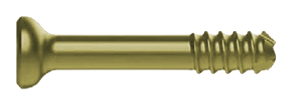
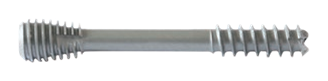
Two headless designs are listed. One threads along nearly the whole working shaft and drives from a recess at its terminal end, in diameters of 2.5, 3.5, 4.5 and 6.5 mm across twenty variants. The other places a thread at each end either side of a smooth centre, the form sometimes described as double-headed cannulated screws, so the two thread zones engage opposite sides of an interface; thirty-eight variants cover 2.5, 3.0 and 4.0 mm. The headed screw pairs a broad, slightly domed head with a smooth shaft and a short distal thread, in 2.0, 3.5, 4.0 and 4.5 mm across fifteen variants.
Beveled head cannulated screws
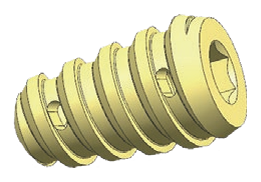
An enlarged head blended into the shaft through a rounded bevel gives the buttress system a wider seating surface at the entry side than a compact head presents, with threads running along most of the shaft. Its guide pin can be introduced through an external parallel aiming device, so the entry point and angle are set before anything advances into bone. Thirty-five variants cover 2.5, 3.0, 3.5 and 4.0 mm.
Subtalar and self-drilling screws
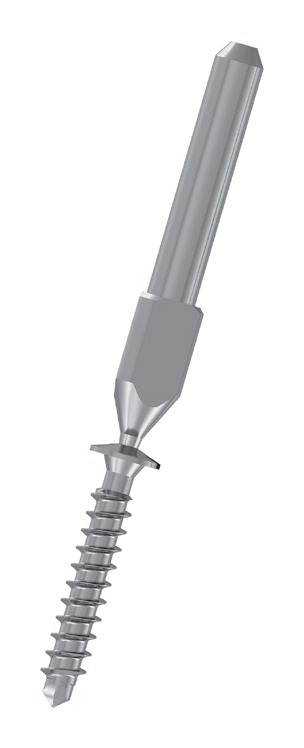
For subtalar joint stabilization a headed screw carries a beveled shoulder, continuous shaft threads and a blunt chamfered tip, in fifteen variants catalogued by a paired size specification. The self-drilling self-tapping screws are the exception to the cannulated pattern: a pointed cutting tip opens the path, the thread forms its own, and a cross recess holds the screw on the driver. Request a Quote for the variant tables.
FAQ
Frequently asked questions
What screw types are in the foot and ankle screw range?
Six titanium alloy implants, plus one matching instrument set: a headed screw with a smooth shaft and a short distal thread, a headless screw threaded along nearly its whole shaft, a headless screw with a thread at each end, a beveled-head buttress system, a headed screw for subtalar joint stabilization, and self-drilling self-tapping screws with a cross recess drive.
What diameters and lengths are catalogued?
The headed screw covers 2.0, 3.5, 4.0 and 4.5 mm across fifteen variants; the full-thread headless screw 2.5, 3.5, 4.5 and 6.5 mm across twenty; the double-ended thread screw 2.5, 3.0 and 4.0 mm across thirty-eight; the buttress system 2.5, 3.0, 3.5 and 4.0 mm across thirty-five. Self-drilling screws come in 2.0 and 2.5 mm across nine lengths between 11 mm and 22 mm.
What does cannulated mean on these screws?
A passage runs the length of the screw along its axis. A guide pin is placed first, setting the entry point and the angle, and the screw is then advanced over that pin, so the trajectory is decided before the implant moves. Five of the six implants here are cannulated; the self-drilling self-tapping screws are the exception and form their own path.
When would a headless screw be chosen over a headed one?
A headless screw has no enlarged head at either end, so its terminal profile stays close to the surrounding surface once seated. The headed forms do the opposite on purpose: the broad domed head and the beveled buttress head present a wider seating surface at the entry side. The choice follows what the construct calls for at that entry point.
Can the buttress screws be placed percutaneously?
The guide pin for the beveled-head buttress system can be introduced through an external parallel aiming device, which sets the entry point and the angle outside the body. Because the screw then travels over that pin, the aiming frame carries the trajectory through to the implant and the freehand alignment step at insertion is removed. A matching instrument set is listed in the same four diameters.
Do you make screws to a customer's specification?
Yes. Kangli Orthopaedics has manufactured orthopaedic implants and instruments since 2002 and works on OEM, ODM and OBM terms. Citizen Cincom Swiss-type lathes suit small-diameter screw work in particular, and an on-site vacuum heat-treatment furnace handles stress relief and annealing, so turning and heat treatment stay on one campus.