

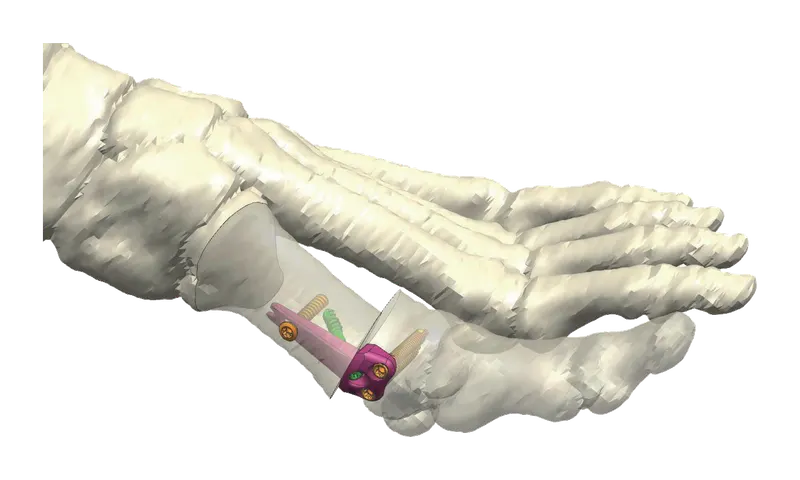
Hallux Valgus Locking Plates
Overview
Range overview
Hallux valgus locking plates in this sub-catalogue are represented by a single titanium alloy design, shaped for the medial forefoot and catalogued as two parts, one left and one right. The plate runs an oblique, gently curved line that tapers through the middle and widens toward both ends, so the narrow section sits over the osteotomy while the fixation openings gather where the plate broadens.
Bunion plates for the medial forefoot
A short, curved run of bone is what bunion plates have to follow, rather than a long shaft, and this one is contoured for that path. Its oblique profile matches the medial forefoot, and the widened ends place several screw positions on either side of the narrower midsection. Side-matched selection puts the widened end and the shaft transition in the orientation the operative setup calls for.
Locking openings across the osteotomy
The openings are threaded to receive compatible locking screw heads, so each seated screw is coupled to the plate rather than held by contact against a smooth surface. Fixation points are distributed along the plate body, letting a construct be planned across the osteotomy zone with the screw positions taken from the operative technique. For the instrumentation side of that work, Kangli Orthopaedics lists a matching beveled-head screw instrument set.
Manufacture and OEM programmes
Suzhou Kangli Orthopaedics has manufactured orthopaedic implants and instruments since 2002, with about 200 staff on a campus of roughly 40,000 square metres. Swiss-type lathes and five-axis machining centres cut the implants; an on-site vacuum furnace handles stress relief and annealing. Devices reach more than 40 countries, 35 of them supplied directly, and OEM, ODM and OBM programmes cover altered geometry and own-brand supply. Request a Quote
FAQ
Frequently asked questions
What is listed in the hallux valgus sub-catalogue?
One titanium alloy locking plate for hallux valgus osteotomy fixation and medial forefoot procedures, catalogued in two parts: a left and a right. Its threaded openings receive compatible locking screw heads, and the widened ends carry several fixation positions on either side of the tapered midsection. A matching beveled-head screw instrument set covers the instrumentation side.
Do you supply hallux valgus compression screws as well?
Not on this page, which lists the plate. Screw fixation for the foot and ankle is catalogued separately in the screws sub-catalogue of the same family. The beveled-head screw instrument set that matches this plate is listed there too, and both sub-catalogues can be quoted together in one enquiry.
Is the plate side-specific?
Yes. Separate left and right models correspond to the intended operative side, and the two variants listed are exactly those. The oblique profile and the transition between the widened end and the narrower shaft are oriented for one side of the forefoot, so a left plate cannot stand in for a right one during surgical setup.
What material is the hallux valgus plate made from?
Titanium alloy. The material is constant across both variants, so the two parts differ by side rather than by alloy. Threaded locking openings are machined into the plate rather than added afterwards, establishing a defined connection between plate and screw along the fixation points distributed on the plate body.
Can the plate be produced under our own brand?
Yes. Kangli Orthopaedics has manufactured orthopaedic implants and instruments since 2002 and runs OEM, ODM and OBM programmes, covering production to a customer's drawings, a geometry developed jointly, and supply under the customer's own brand. In-house CNC machining and an on-site vacuum heat-treatment furnace keep cutting, stress relief and annealing on one campus.