
Distal Ulnar Locking Hook Plate
Specification
- Material
- Pure Titanium
- Length
- 45 mm
- Holes
- 8
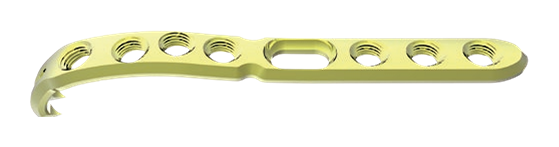
Kangli Orthopaedics manufactures this distal ulnar locking hook plate from pure titanium for orthopedic implant applications involving distal ulna fracture fixation. Its curved hook forms the distal end of the implant, while the contoured plate body incorporates threaded locking holes and a central oval slot along the ulnar side. The hook provides a defined distal reference point, and the combination of threaded holes and an adjustment slot accommodates plate positioning and locking screw engagement.
Hooked Geometry for Distal Ulnar Positioning
The distal end curves downward and inward beneath the plate body. This hooked profile follows the distal ulnar edge and creates a dedicated contact area at the terminal end of the implant, rather than relying solely on a flat plate edge.
Threaded Holes for Locking Screw Placement
A longitudinal row of circular threaded holes follows the contoured plate body. Raised or chamfered rims surround the openings, while the internal threads accept compatible locking screws directly through the plate. This configuration provides multiple screw-placement points along the distal ulna.
Oval Slot for Controlled Plate Adjustment
A recessed, elongated oval slot is positioned centrally within the plate and separates the threaded openings. It provides an adjustment path during initial positioning, allowing the plate to be shifted along its curved axis before locking screws are placed in the threaded holes.
Orthopedic Applications for Distal Ulna Fixation
- Distal ulna fracture fixation
- Hooked fixation at the distal ulnar edge
- Ulnar-sided plate positioning along the distal forearm
- Locking screw placement through the threaded hole row
For fixation procedures involving the opposite end of the ulna, distributors and physicians may also review the Proximal Ulnar Locking Plate as a separate implant option.