

Forearm Locking Plates

Overview
Range overview
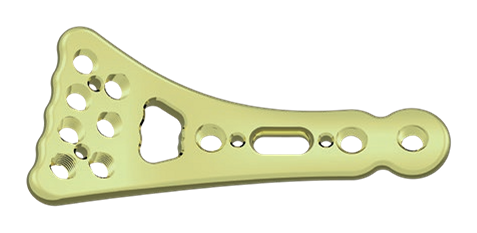
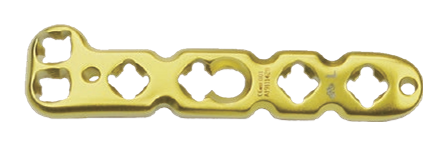
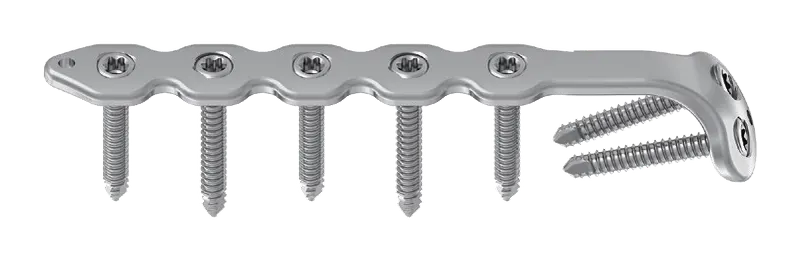
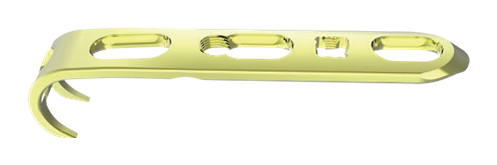
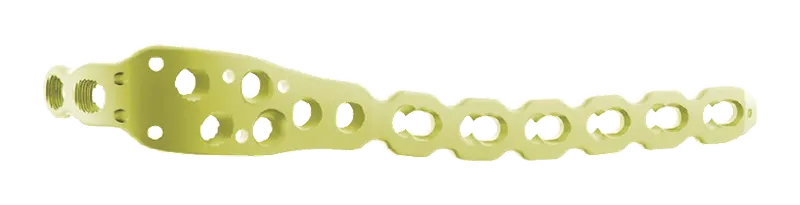
Eleven designs make up this range of forearm locking plates, each drawn around a region of the radius or ulna rather than cut from one blank. Kangli Orthopaedics machines all of them from pure titanium, in eighty-five configurations: broad buttress ends for the distal radius, a fan-shaped section for the radial head, hooked terminals for the olecranon, and straight bodies for the shafts.
Distal radius locking plates, column by column
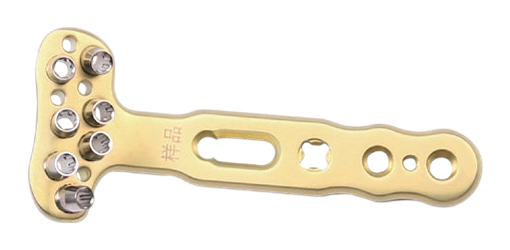
Five designs cover the distal radius. The Distal Radial Locking Plate ships with its own drill guide and a universal head interface, so each screw can be rotated within its opening instead of following one fixed axis. The buttress version spreads a staggered aperture cluster across the distal fragment in six lengths from 55 to 127 mm. The radial-column plate follows a single column at 50 and 55 mm, the intermediate-column plate at 50 mm.
Radial head plates and the forearm shafts
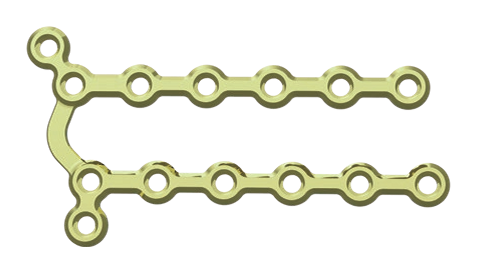
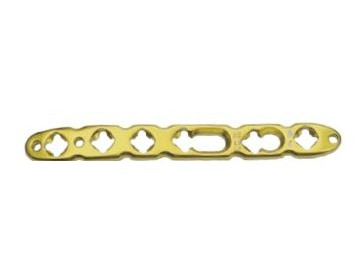
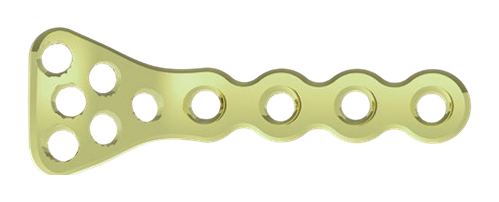
At the elbow end of the radius, a fan-shaped head section concentrates small apertures and hands off to larger openings along the shaft, in lengths of 40, 48 and 56 mm. Away from either joint, the Ulnar and Radial Shaft Locking Plate keeps a narrow linear body with paired-lobed openings, in seven hole counts from 5 to 12.
Ulna locking plates from the olecranon down
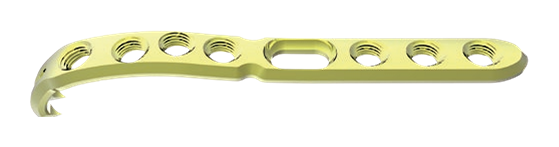
Four designs address the ulna. A contoured proximal plate combines threaded holes across the head with elongated shaft slots; a locking compression hook version adds an integrated capture point at the proximal margin; and the Olecranon Hook Reconstruction Locking Plate sets vertical openings inside its hooked terminal across three lengths.
Sided forms and OEM supply
Seven of the eleven designs are listed in left- and right-sided forms, so contour and hole orientation follow the side addressed. Kangli Orthopaedics manufactures the range in-house on OEM, ODM and OBM terms. Request a Quote for the full listing.
FAQ
Frequently asked questions
What does the Kangli forearm plate range cover?
Eleven designs across the radius and the ulna. On the radial side: a distal radial plate supplied with a drill guide, a buttress version, a dorsal configuration, radial-column and intermediate-column plates, and a radial head plate. On the ulnar side: proximal ulnar plates in standard and hook forms, an olecranon hook reconstruction plate, and a distal ulnar hook plate. A straight shaft plate serves either bone.
Which forearm plates come in left and right versions?
Seven of the eleven. The distal radial plate with drill guide, the buttress plate, the dorsal plate, the radial head plate, the intermediate-column plate, the proximal ulnar plate and the olecranon hook plate are each listed in left- and right-sided forms, with the contour and hole orientation mirrored. The shaft plate, the radial-column plate and the two single-variant hook plates are not sided.
What material are the plates made from?
Every design in this range is machined from pure titanium. Kangli Orthopaedics cuts them on CNC equipment including DMG five-axis centres, Citizen Cincom Swiss-type lathes and Haas centres, and runs an on-site vacuum heat-treatment furnace for stress relief and annealing.
What hole counts and lengths are available?
They vary by design. The buttress plate runs six lengths from 55 to 127 mm; the shaft plate offers seven hole counts of 5, 6, 7, 8, 9, 10 and 12; the radial head plate comes at 40, 48 and 56 mm in 3-, 4- and 5-hole forms; the olecranon hook plate at 87, 113 and 139 mm in 4, 6 and 8 holes.
Which plate suits a multi-fragment distal radius?
The Distal Radial Locking Plate with drill guide. Its universal head lets each screw rotate within its opening rather than sit on a fixed axis, so adjacent screws in one distal cluster can be aimed at separate fragments from the same plate position. Dedicated distal openings direct screws toward the radial styloid, the lunate articular line and the distal ulnar-radial region.
Can these plates be supplied under our own brand?
Yes. Kangli Orthopaedics is a manufacturer offering OEM, ODM and OBM arrangements for orthopaedic implants and instruments, working from a campus of roughly 40,000 square metres with about 200 staff. The company sells directly into 35 countries and its devices reach more than 40. Use the Request a Quote form to open a discussion.