


Distal Fibula Locking Plates
Overview
Range overview
Kangli Orthopaedics manufactures distal fibula locking plates in pure titanium, in two families that differ in the shape of the distal end. One carries a broad rounded head for reconstruction spanning the distal fibula and the shaft above it; the other widens into an irregular distal profile shaped for the lateral side of the bone. Both are supplied in left and right forms, and each carries a chamfered or scalloped perimeter rather than a squared edge.
Lateral malleolus plates and the fibular shaft
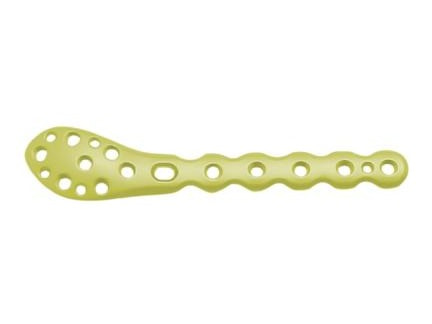
The Distal Fibular Lateral Locking Plate concentrates closely spaced openings across its head, then continues as a longitudinal row of circular locking holes along a narrow shaft. Oval slots mark the transition and leave room for lengthwise adjustment before those locking holes are used. Eighteen variants are catalogued for this plate, across nine lengths from 71 mm to 138 mm and hole counts of three, four, five, six, seven and eight.
Fibular fracture plates for the distal-to-shaft transition
A broad, rounded distal head meets a tapered, scalloped shaft on the Distal Fibular Reconstruction Locking Plate, so the body narrows as it runs proximally instead of carrying the full head width along its whole length. An elongated oval opening sits where head meets shaft, giving positioning room before final screw placement. Ten variants cover five lengths from 68 mm to 148 mm in even hole counts of four, six, eight, ten and twelve, each left and right.
Titanium plates machined in-house
Both families are cut on Kangli's own CNC turning and milling centres, with an on-site vacuum heat-treatment furnace handling stress relief and annealing. The company has manufactured orthopaedic implants since 2002, sells directly into 35 countries, and takes OEM, ODM and OBM work on plates in this range. For the fibular section of the catalogue, request a quote.
FAQ
Frequently asked questions
What is the difference between the two fibular plates?
The Distal Fibular Lateral Locking Plate widens into an irregular distal profile with closely spaced openings, then continues as a single row of circular locking holes along a narrow shaft. The Distal Fibular Reconstruction Locking Plate instead pairs a broad, rounded head with a tapered, scalloped shaft, narrowing as it runs proximally along the bone.
Are the fibular plates supplied for left and right?
Both families are sided. The lateral plate is catalogued in eighteen variants, in three, four, five, six, seven and eight holes, each in a left and a right form. The reconstruction plate is listed in ten variants, in four, six, eight, ten and twelve holes, again in matched left and right forms.
What lengths are available?
The lateral plate covers nine lengths of 71, 84, 86, 97, 110, 112, 123, 136 and 138 mm. The reconstruction plate covers five lengths of 68, 88, 108, 128 and 148 mm. Between the two families, 28 variants are catalogued in total, so a length can be matched to the planned span along the fibula.
What material are the fibular plates made from?
Both are machined from pure titanium. Kangli produces them on its own CNC turning and milling equipment and runs an on-site vacuum heat-treatment furnace for stress relief and annealing. The reconstruction plate has a thin, flat profile with scalloped shaft edges, while the lateral plate carries a gently chamfered perimeter and a rounded terminal tip.
Do you accept OEM or ODM orders for fibular plates?
Yes. Kangli Orthopaedics has manufactured orthopaedic implants and instruments since 2002 from a campus of around 50 acres, and works as an OEM, ODM and OBM manufacturer. Devices reach more than 40 countries, 35 of them supplied directly. Send the geometry, hole pattern and material required through Request a Quote.