

Scapula Locking Plates
Overview
Range overview
Scapula locking plates have to answer to an irregular bone, and Kangli Orthopaedics catalogues four separate geometries rather than one adaptable design. Each is machined from pure titanium and each is supplied in left and right forms: a glenoid plate, a lateral border plate, a medial border plate, and an acromial plate carrying an extended clavicular stem. Between them they follow the glenoid rim, both scapular borders and the acromial transition.
Glenoid, border and acromial geometries
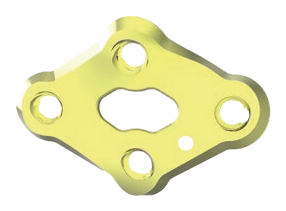
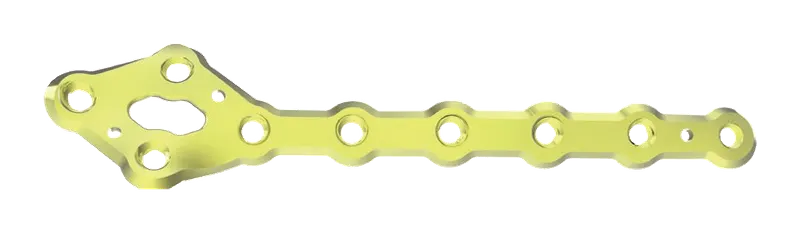
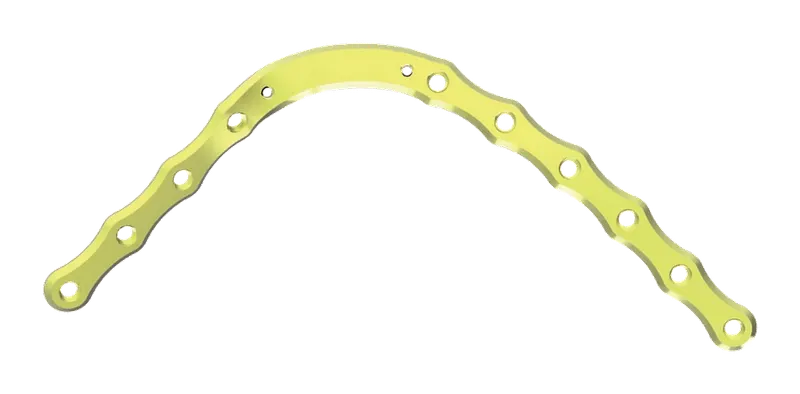
The glenoid plate has a lobed body with rounded peripheral extensions, so its four locking apertures sit around the perimeter rather than along a central line; an elongated slot inside the main body allows the position to be refined before any screw is placed. The lateral border plate widens at one end and tapers into a narrow shaft carrying nine openings, one of them an elongated slot. The medial border plate arches between two descending arms, with ten apertures in a single curved row and recessed rims that seat each screw head.
The acromial plate and its clavicular stem
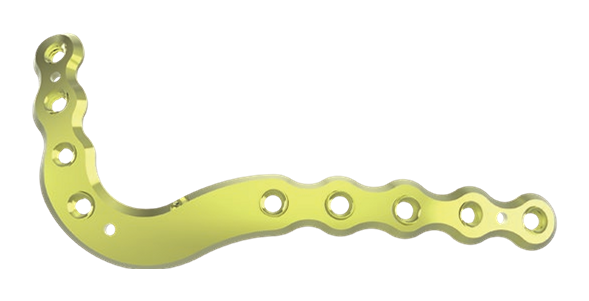
The acromial plate turns through a broad rounded bend into an elongated arm, a J-shaped path that carries the fixation line from the acromial region toward the adjoining clavicular segment. Beveled apertures seat the screw heads below the plate surface, and scalloped cutouts between them keep the stem contoured rather than flat. Twelve variants run to five lengths: 90, 109, 122, 136 and 162 mm, including a shortened seven-hole form.
Scapular fracture fixation plates made to order
Every plate here is sided, so an order names left or right alongside the hole count. Scapula plates are machined on the company's own five-axis centres and stress-relieved in an on-site vacuum furnace, and the same tooling supports OEM, ODM and OBM programmes. Founded in 2002, Kangli sells directly into 35 countries.
For the full size table, request a quote.
FAQ
Frequently asked questions
Which parts of the scapula does the range cover?
Four regions, one plate each. The glenoid plate is shaped for the glenoid and its rim, the lateral border plate runs along the lateral border, the medial border plate arches along the medial border, and the acromial plate covers the acromial region with a stem extending toward the clavicular segment. All four are listed for scapular neck fixation as well, and the two border plates for scapular body fractures.
Is every plate sided?
Yes. All four geometries are catalogued in left and right forms and nothing in the range is symmetrical, because each follows a contour that differs between the two sides. The glenoid plate is listed as 4L and 4R, the lateral border plate as 9L and 9R, the medial border plate as 10L and 10R, and the acromial plate across four hole counts.
How many screw openings does each plate carry?
The glenoid plate carries four locking apertures arranged around a lobed perimeter, with an elongated slot in the main body for positioning. The lateral border plate carries nine, one of them a slot near the broad end. The medial border plate carries ten in a single curved row. The acromial plate is catalogued in 7, 8, 9 and 11-hole forms, including a shortened seven-hole version.
What is the acromial plate's clavicular stem for?
It carries the fixation line beyond the acromial bend and toward the adjoining clavicular segment, so one implant spans the transition rather than stopping at the acromion. The stem is scalloped between its apertures, which keeps a contoured profile instead of a wide flat strip. Twelve variants run to five lengths: 90, 109, 122, 136 and 162 mm.
Can scapular plates be made under an OEM programme?
Yes. Kangli manufactures rather than trades, and OEM, ODM and OBM work runs through the same machine shop as the catalogued range — DMG five-axis centres, Swiss-type lathes and an on-site vacuum furnace for stress relief and annealing. A partner can commission a modified geometry or take an existing plate under its own brand.