
Lateral Border Scapular Locking Plate
Specification
- Material
- Pure Titanium
- Holes
- 9
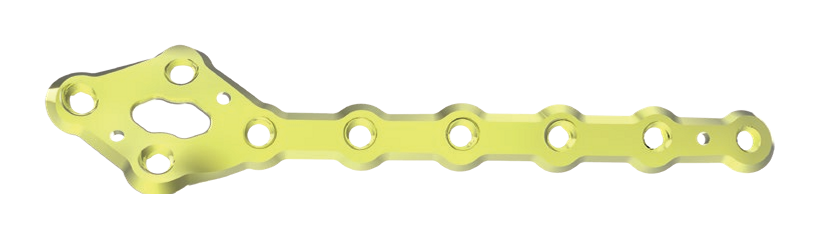
Kangli Orthopaedics manufactures this pure titanium plate for use along the lateral border of the scapula. Its broad, contoured end transitions into a narrower shaft, combining circular apertures and an elongated slot within a thin, gently scalloped profile. Left- and right-sided options correspond to the relevant scapular side.
Contoured Geometry for the Lateral Scapula
The widened, irregular end is shaped for the broader lateral region of the scapula, while the shaft gradually narrows as it extends along the border. This configuration places multiple fixation apertures across the transition between the lateral region and the narrower border.
Narrow Shaft for Lateral Border Alignment
The central bar follows a tapered profile with a gently contoured outline. Repeated scallops surround the apertures, creating a segmented edge that corresponds with the changing width of the lateral scapular border.
Elongated Slot for Plate Positioning
An elongated, rounded slot is positioned near the broad end alongside circular screw apertures. The slot provides longitudinal adjustment during plate placement, while the circular apertures offer defined screw positions.
Beveled Edges Around Screw Apertures
Chamfered perimeter edges and beveled aperture rims provide gradual transitions around the plate and its openings. These details give the implant a defined entry surface and a smoothly changing external profile.
Orthopedic Applications Along the Scapular Border
Application areas include:
- Lateral-border scapular fracture fixation
- Scapular neck fracture fixation
- Scapular body fracture fixation along the lateral border
The lateral-border configuration may be reviewed alongside the Glenoid Locking Plate when the fracture line is positioned closer to the glenoid rather than along the lateral border.