

Pelvic Reconstruction Plates
Overview
Range overview
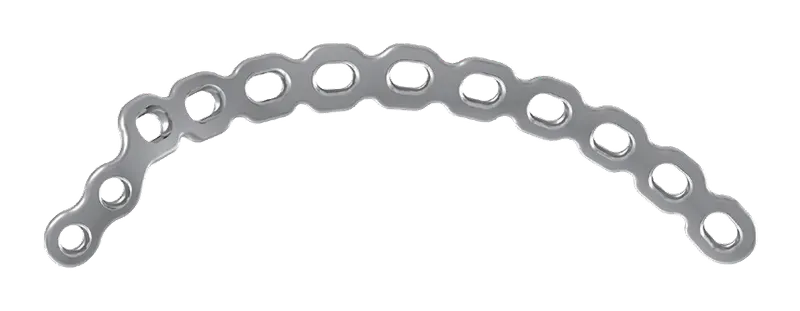
Pelvic reconstruction plates from Kangli Orthopaedics run to five designs, every one machined from pure titanium and shaped for a particular region of the pelvis. The contour is taken from the anatomy rather than bent into a straight bar to meet it: a broad arc for the posterior acetabular wall, a shallow sinuous line for the pubic region, a segmented curve across the iliopubic junction, and a horizontal bridge for the anterior sacroiliac joint.
Curved and straight reconstruction profiles
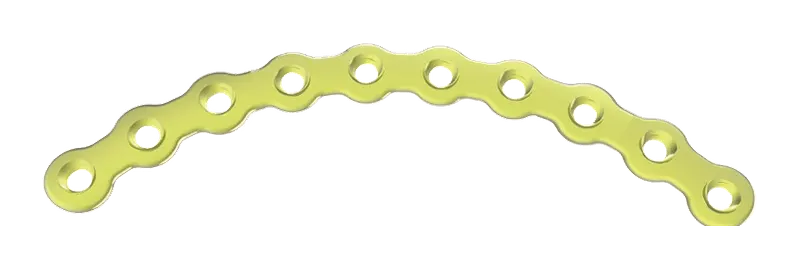
The Pelvic Reconstruction Locking Compression Plate comes in two profiles: a shallow continuous arch that rises gently toward rounded terminal lobes, and a straight version for a direct fixation path. Fourteen configurations cover nine hole counts from 5 to 20 and fourteen lengths from 62 to 258 mm.
Acetabular plates for the posterior wall
A convex outer edge and concave inner edge give the Acetabular Plate Series a broad arc, placing its apertures along the acetabular contour end to end. The ends descend from the central crest into rounded, slightly tapered tips, which is the hook profile of the Posterior Wall Hook Acetabular Plate. Two forms are catalogued, at 3 and 9 holes.
Pubic symphysis plates and the iliopubic junction
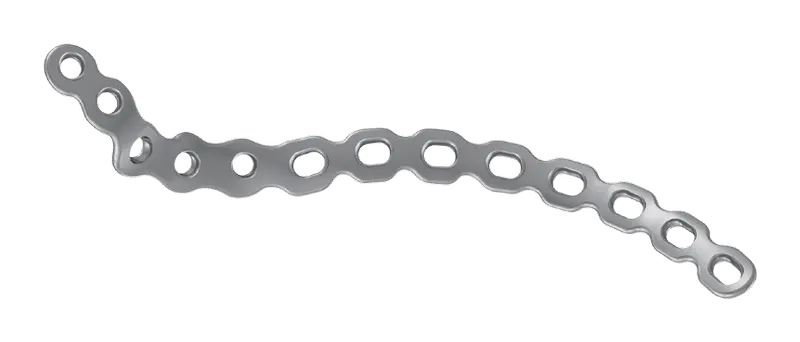
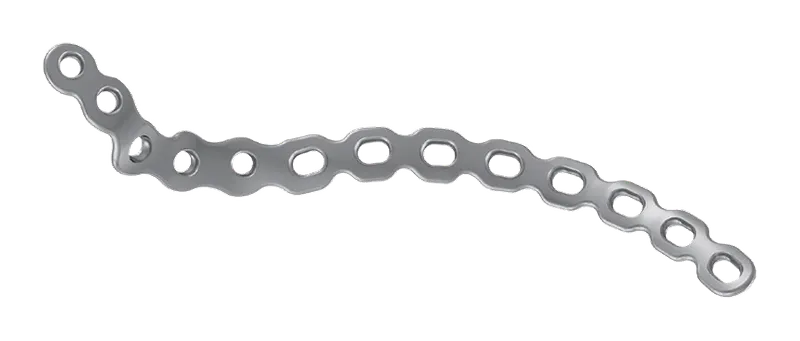
The Pubic Plate Series follows a shallow sinuous contour along the anterior pelvic ring, its openings elongated through the centre and rounder toward the ends. Asymmetric ends identify the left- or right-sided orientation, in 8- and 12-hole forms. Alongside it, the 13-hole Iliopubic Junction Plate widens into a broad central span before tapering to a rounded end.
Sacroiliac joint plates and OEM supply
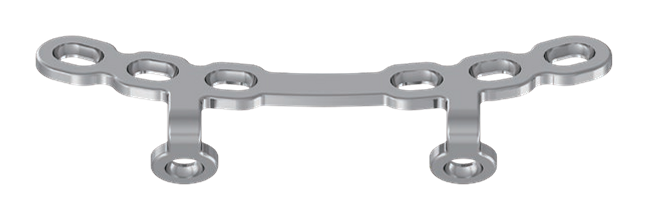
A broad bridge crosses the anterior joint line in the 4-hole Anterior Sacroiliac Joint Plate, with short downward projections that each carry their own opening. Kangli Orthopaedics manufactures the range in-house on OEM, ODM and OBM terms. Request a Quote for the full listing.
FAQ
Frequently asked questions
What does the Kangli pelvic plate range cover?
Five designs. A reconstruction locking compression plate in curved and straight profiles, an acetabular series with a posterior wall hook plate, a pubic series for the anterior ring, a single iliopubic junction plate, and an anterior sacroiliac joint plate. Together they cover the posterior wall, the anterior ring, the junction between them and the sacroiliac region.
Do you list iliopectineal plates?
The plate catalogued here for the anterior iliopubic junction is the Iliopubic Junction Plate, a single 13-hole design in pure titanium. Its segmented, sinuous profile runs from a narrower end into a wider central span before tapering to a rounded end, and a continuous bridge of plate material sits between the inner apertures. Beveled, countersunk rims give each opening a defined entry through the plate thickness.
What lengths and hole counts does the reconstruction plate come in?
Fourteen configurations. The hole counts are 5, 6, 8, 10, 12, 14, 16, 18 and 20, and the lengths run 62, 74, 76, 98, 102, 122, 128, 146, 154, 170, 180, 206, 232 and 258 mm. Curved and straight profiles share the same sequence of evenly spaced apertures, so the choice between them is about the fixation pathway rather than the hole pattern.
Are the pubic plates sided left and right?
Yes. Asymmetric ends, rounded lobes and the staggered aperture arrangement identify the orientation, so the plate follows the changing line of the pubic region on the side involved. Two forms are catalogued, at 8 and 12 holes. The other four designs in the range are described by profile and hole count rather than by side.
What material are the pelvic plates made from?
Pure titanium across all five designs, from the 4-hole sacroiliac plate to the longest reconstruction profile. Kangli Orthopaedics machines them on CNC equipment including DMG five-axis centres, a DMG CTX beta 1250 TC turn-mill centre and Haas centres, with an on-site vacuum heat-treatment furnace for stress relief and annealing.
Can pelvic plates be supplied under our own brand?
Yes. Kangli Orthopaedics is a manufacturer offering OEM, ODM and OBM arrangements for orthopaedic implants and instruments, founded in 2002 with about 200 staff on a campus of roughly 40,000 square metres. The company sells directly into 35 countries and its devices reach more than 40. Use the Request a Quote form to open a discussion.