
Olecranon Hook Reconstruction Locking Plate
- Trauma Plates & Fixation
- Forearm
- Reconstruction
- Hook
Specification
- Material
- Pure Titanium
- Holes
- 4 - 8
- Length
- 87 - 139 mm
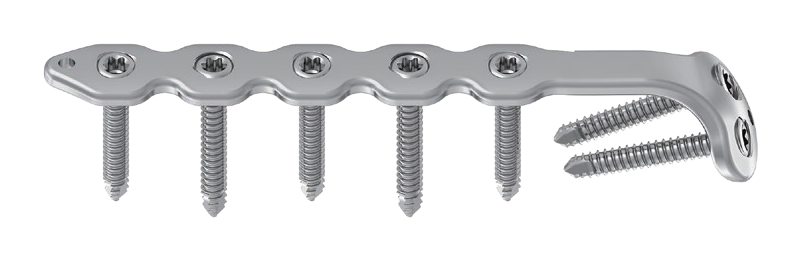
Kangli Orthopaedics manufactures this pure titanium reconstruction plate for olecranon and proximal ulna fixation. Its downward-curved hook follows the terminal olecranon region, while the contoured horizontal body incorporates locking openings along the shaft and through the hooked end. Rounded margins, scalloped intervals between openings, and left- and right-sided options support selection for the corresponding forearm anatomy.
Hooked Terminal Section for Olecranon Fixation
The terminal section curves downward from the main plate body and includes vertically arranged openings within the hook. This configuration provides a dedicated fixation area near the olecranon tip, while the straight section continues along the proximal ulna.
Locking Screw Openings Along the Proximal Ulna
Circular openings extend across the horizontal body and curved terminal section. Their recessed interfaces accommodate compatible locking screws and create a continuous screw-placement path from the hooked olecranon region toward the ulnar shaft.
Contoured Edges for Proximal Ulna Plate Fit
Scalloped intervals shape the lower plate edge between the openings, with the surface rising gently around each screw site. This profile reduces the appearance of a continuous straight edge and follows the changing contour of the proximal ulna.
Left- and Right-Sided Plate Options
The plate is available in left and right versions, with the hook oriented for the corresponding ulna. Multiple lengths extend the same hooked configuration across different portions of the forearm, allowing selection of a shorter proximal fixation path or a longer shaft reach.
Orthopedic Fixation Applications
- Olecranon fracture fixation
- Proximal ulna fracture fixation
- Hook plate fixation around the olecranon tip
- Contoured locking plate fixation for the forearm
This plate can be considered alongside the Proximal Ulnar Locking Plate when the required proximal ulna profile includes a hooked terminal section.