

Interbody Fusion Cages
Overview
Range overview
Interbody fusion cages from Kangli Orthopaedics are listed in three formats: a compact cervical cage, a longer thoracolumbar cage, and a cylindrical lattice implant in pure titanium. The first two are made in either PEEK or titanium alloy, so one geometry can be specified in either material; the lattice is pure titanium and carries its own cover component. Serrations, teeth, openings and edge treatments differ by format.
Cervical cage geometry and the zero-notch alternative
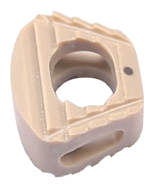
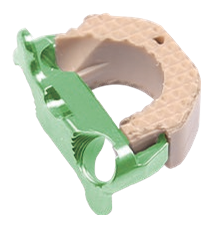
The cervical cage has a rounded-rectangular body with a large central through-opening bordered by a raised rim, transverse serrations across the upper and lower faces, and chamfered transitions into the sidewalls. Specifications 4 through 9 are listed, alongside a combined entry pairing 15 with 4.5, 5.5, 6.5, 7.5 and 8.5. This is a block-shaped profile; cervical zero-notch cages are the curved alternative, listed under Cervical Spine rather than here.
Thoracolumbar fusion cages for thoracic and lumbar levels
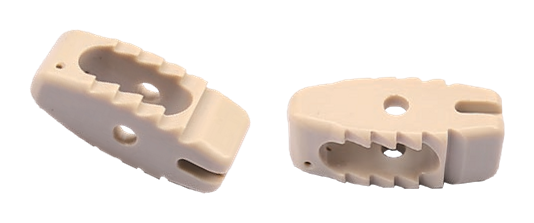
A broad longitudinal opening runs through the thoracolumbar cage, framed by stepped edges, with rectangular teeth beside the opening and matching stepped projections opposite. Rounded corners, a curved end cap and chamfered transitions carry the contour around it. Listed specifications pair 8 through 14 with 22 and 26, and further entries extend 8 and 10 across 20, 22, 26, 32 and 36.
PEEK cages, titanium alloy and a pure titanium lattice
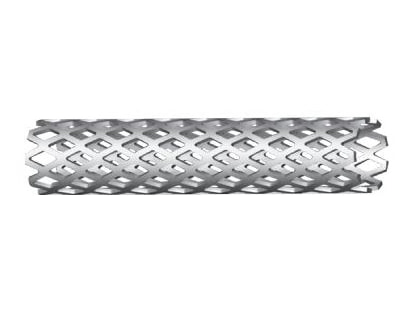
Material is a specification choice on the two block formats: PEEK cages and titanium fusion cages share one body geometry, and the titanium versions are named separately. The lattice implant is different in kind: intersecting diagonal struts form its wall, with staggered diamond and lozenge apertures around the circumference and angled, stepped ends rather than flat faces. It comes in diameters of 10, 12, 14, 16, 19 and 24 mm, the cover listed as its own part. Component lists and material options follow a quote request.
FAQ
Frequently asked questions
Which cage formats are listed?
Three. A cervical cage with a rounded-rectangular body and transverse serrations; a thoracolumbar cage with a longitudinal opening and rectangular teeth along its edges; and a pure titanium cylindrical lattice implant with a separate cover component. The first two are offered in PEEK or titanium alloy, so the same body geometry can be specified in either material.
Are the PEEK and titanium versions the same geometry?
On the cervical and thoracolumbar formats, yes. Material is a specification choice against one body design, and the titanium versions are named separately in the catalogue so they can be handled as distinct lines. The cylindrical lattice implant is a different design altogether, built from intersecting struts, and it is listed only in pure titanium.
What sizes does the thoracolumbar cage come in?
Listed specifications pair 8 through 14 with 22 and 26, and further entries extend 8 and 10 across 20, 22, 26, 32 and 36. Because the combinations are enumerated rather than continuous, it is worth confirming the exact pairing wanted when a shortlist is drawn up. The current specification list is supplied with a quote request.
What is the cover for the titanium lattice cage?
The Cover for Titanium Cage is the closure component listed alongside the lattice body for configurations that include one. Treating it as a separate part keeps it distinct from the cage body during inventory management, selection and assembly planning. The lattice body itself is listed in diameters of 10, 12, 14, 16, 19 and 24 mm.
Where are the zero-notch cervical cages listed?
Not on this page. The cervical cage in this sub-catalog is the block-shaped, serrated format. The curved cage with a zero-notch anterior profile sits under Cervical Spine, where it is kept beside the anterior plate it can be specified with. Both are cervical interbody implants, so it is worth checking which profile a shortlist actually means.