

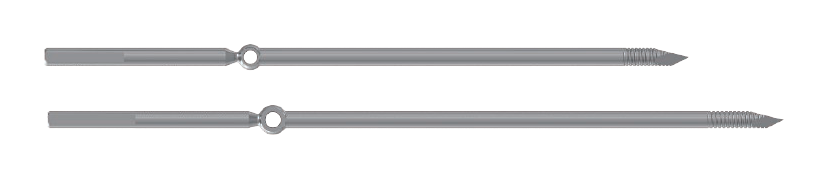
Tension Band Pin
Specification
- Material
- Titanium Alloy
- Diameter
- 2.0 mm, 2.5 mm
- Length
- 60 - 120 mm
Kangli Orthopaedics manufactures the Tension Band Pin from titanium alloy for wire-based fixation procedures involving the patella. The pin combines a straight shaft, integrated eyelet, and tapered pointed tip in one component. Diameter and length options allow distributors and orthopedic professionals to select a configuration that corresponds to the prepared fixation path while retaining the same eyelet-based wire-routing design.
Integrated Eyelet for Tension-Band Wire
The circular eyelet provides a dedicated passage for tension-band wire through the pin. This configuration creates a defined wire capture point and keeps the wire associated with the pin during assembly and placement.
Tapered Tip for a Focused Entry Point
The shaft narrows toward its pointed distal end. This tapered geometry presents a concentrated leading point for advancement along the planned insertion path, followed by the straight shaft.
Straight Shaft for Linear Pin Placement
The pin’s straight shaft maintains a consistent axis between the blunt end and pointed tip. This design supports linear placement across patellar fracture fragments while keeping the integrated eyelet oriented along the wire-routing path.
Titanium Alloy and Multiple Size Options
The titanium alloy construction is offered in multiple diameter and length configurations. Diameter selection corresponds to the prepared path, while length determines the extent of shaft projection and positioning. The integrated eyelet remains incorporated into every configuration.
Applications in Patellar Fixation Workflows
The Tension Band Pin can be incorporated into workflows involving:
- Patellar fracture fixation
- Wire-based fixation around patellar fragments
- Pin placement across the patella
- Tension-band wire routing through an integrated eyelet
For patellar fixation planning, it may be considered alongside a Patellar Locking Plate when the construct requires a pin with a dedicated eyelet-based wire path rather than a lattice plate configuration.