
Titanium Cable Fixation System
Specification
- Packaging Form
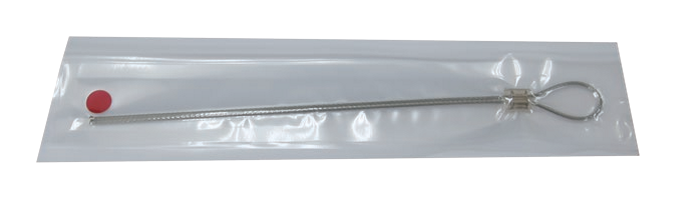
- Sterile Packaging
- Material
- Titanium Alloy
- Diameter
- 1.3 - 1.9 mm
- Length
- 520 mm
- Specification
- 3.5 - 14
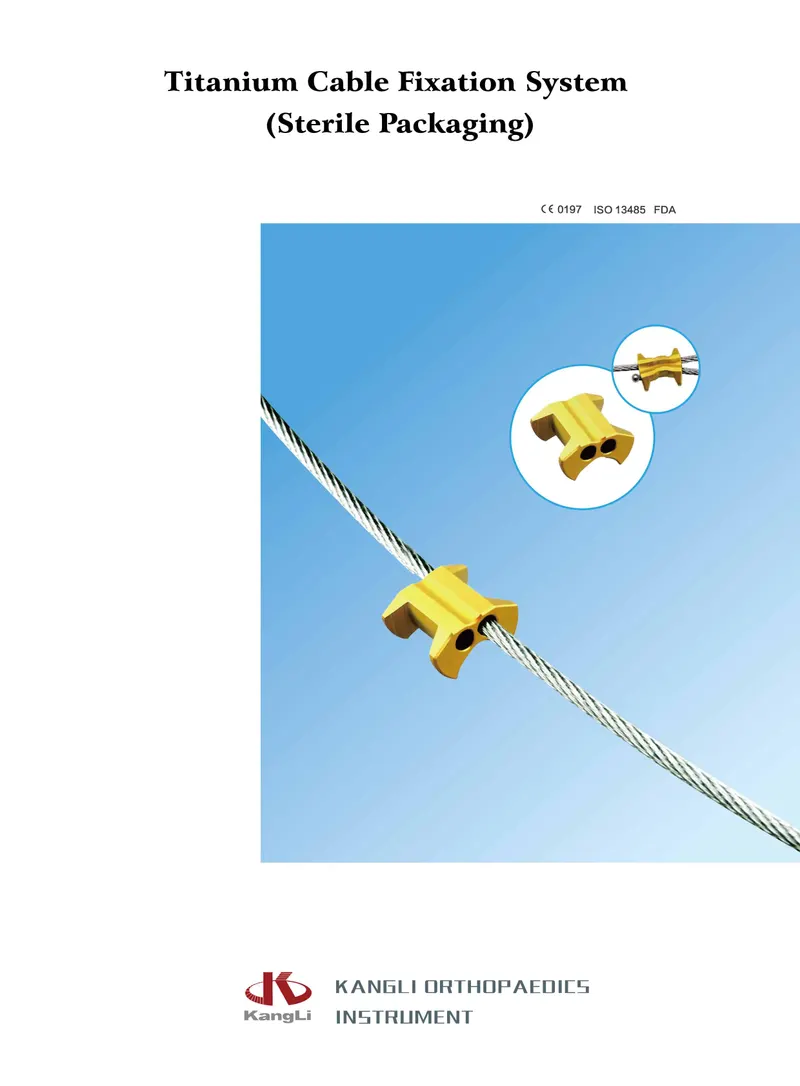
Kangli Orthopaedics supplies this titanium cable fixation system for cable routing, fixation, and tensioning in general trauma procedures. The assembly includes a Metal Titanium Cable made from multiple twisted titanium alloy wires, a Fasten Buckle that secures the cable without manually twisting it, a Cable Filling Cap, and a Locking Connecting Screw for attachment at a compatible fixation interface. Cables are supplied across four diameters at a single length.
Stranded Alloy Wire Construction
The cable body is built from multiple twisted titanium alloy wires rather than a single solid wire. Stranding gives the body its flexibility: it bends while being routed around a fixation site and holds position along a curved path instead of resisting the turn. Load is distributed across many fine wires — static strength together with fatigue strength under repeated load.
Strain Resistance Under Tension
Load in this construct runs along the length of the cable, and the twisted strands carry it as a continuous body. The cable resists strain under that pull, so the tension set with the tightener is carried by the strands rather than by a twist. That is what makes the cable format suitable for tensioned loop fixation.
Locking Without Twisting the Wire
The Fasten Buckle captures the cable and secures the loop at the position selected. Locking happens through the buckle mechanism, so no wire ends are wound together to hold the loop and the manual twist step does not form part of the sequence.
Precise Tension Control Before Lock-Off
Tension is set with a tightener rather than by hand, so the load in the loop is applied precisely and held while the buckle is closed. Setting the tension and locking it are separate steps rather than one combined pull-and-twist.
Attachment to Plate Fixation Constructs
Once the cable is routed and tensioned, the Locking Connecting Screw makes the connection with a compatible fixation interface, giving a defined attachment point for plate-based trauma constructs. The system is used with the Straight Reconstruction Locking Plate when cable tensioning is combined with plate fixation. Locking Connecting Screws are offered in two specifications.
Applications in Trauma Fixation
- Titanium cable fixation in general trauma procedures
- Cable tensioning around a reconstruction plate
- Cable attachment to a locking fixation plate
- Looped cable fixation secured with a buckle mechanism