

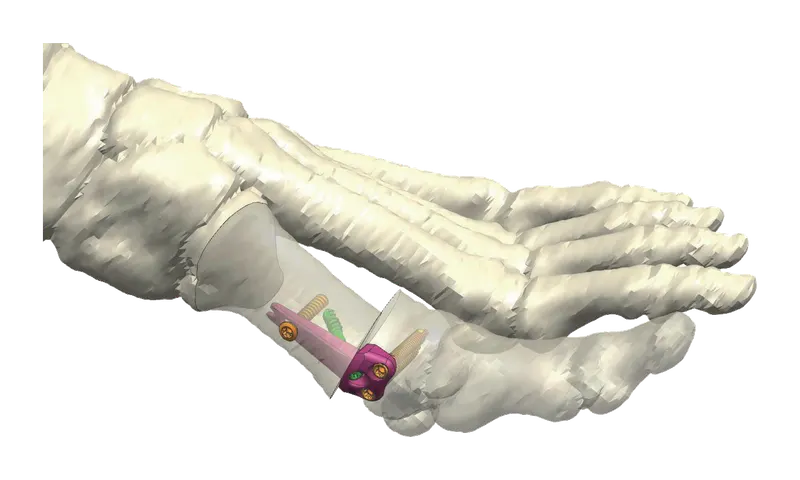
Midfoot Locking Plates
Overview
Range overview
Midfoot locking plates are grouped in this sub-catalogue with the rest of Kangli Orthopaedics' fixation for the middle and front of the foot, kept apart from the hindfoot and distal tibia groups because the bones are smaller and the construct is more often built across a joint than along a fracture line. Suzhou Kangli Orthopaedics has manufactured orthopaedic implants and instruments since 2002 and produces under OEM, ODM and OBM programmes.
Fusion plates for the TMT and MTP joints
Two joint groups organise this part of the foot. TMT fusion plates address the tarsometatarsal joints, where the midfoot meets the bases of the metatarsals; MTP fusion plates address the metatarsophalangeal joints at the front of the foot. What both have in common is a fixation line that crosses a joint rather than following a fracture along a shaft. Configurations in current production are confirmed against the working catalogue rather than fixed on this page.
Variable-angle medial column plates
Along the medial column, the line running from the hindfoot through the navicular and medial cuneiform to the first metatarsal, a plate has to accept screws on more than one trajectory. Variable-angle medial column plates carry that requirement in the seat itself, so a screw can be locked across a cone of angles rather than on a single fixed axis. Midfoot compression screws serve the same region where the plan calls for screw fixation instead of a plate.
Made in Suzhou, to your specification
Swiss-type lathes, five-axis machining centres and a turn-mill centre cut the implants, and an on-site vacuum furnace handles stress relief and annealing, keeping both on one campus of roughly 40,000 square metres with about 200 staff. Kangli sells directly into 35 countries. Name the joints, spans and hole counts your market asks for and the range can be quoted to that specification. Request a Quote
FAQ
Frequently asked questions
What does the midfoot and forefoot sub-catalogue cover?
Fixation for the middle and front of the foot: plates crossing the tarsometatarsal joints, plates crossing the metatarsophalangeal joints, plates following the medial column, and compression screws for the same region. It sits between the calcaneus and hindfoot sub-catalogue behind it and the hallux valgus sub-catalogue in front of it, within Kangli Orthopaedics' wider foot and ankle family.
What is the difference between TMT and MTP fusion plates?
The joint each crosses. TMT fusion plates span the tarsometatarsal joints, where the cuneiforms and cuboid meet the bases of the metatarsals in the midfoot. MTP fusion plates span the metatarsophalangeal joints, where the metatarsal heads meet the proximal phalanges at the forefoot. Both cross a joint rather than following a shaft, but the anatomy differs in bone size and in the span the plate has to cover.
What is a variable-angle medial column plate?
A plate for the column running from the hindfoot through the navicular and medial cuneiform to the first metatarsal, whose screw seats accept more than one trajectory. Rather than fixing each screw on a single axis set by the hole, a variable-angle seat allows the screw to be locked across a cone of angles, so the direction can follow the bone available.
Can Kangli manufacture midfoot and forefoot plates to our own design?
Yes. The company has manufactured orthopaedic implants and instruments since 2002 and works on OEM, ODM and OBM terms: production to a customer's drawings, a geometry developed jointly, or supply under the customer's own brand. CNC turning and milling, five-axis machining and an on-site vacuum heat-treatment furnace keep cutting, stress relief and annealing on a single campus.
How do I see the current midfoot and forefoot range?
Use the Request a Quote form and name the joints you fix most often, the plate spans and hole counts your market asks for, and whether screws are wanted alongside the plates. Kangli replies with the working catalogue pages and variant tables for this region rather than a single generic file, and can quote OEM and ODM work at the same time.