Pedicle Screw Systems
Range overview
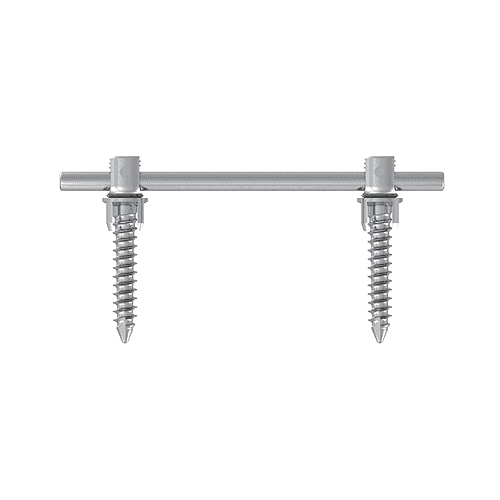
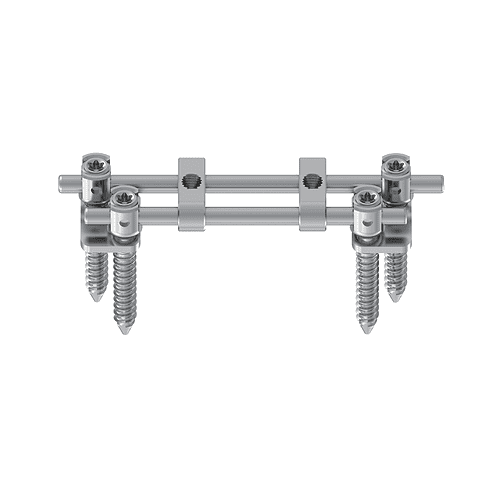
Pedicle screw systems from Kangli Orthopaedics are built around three titanium alloy polyaxial screws for posterior spinal fixation and fusion constructs: a minimally invasive screw, a low-profile screw with short-tail and break-off head options, and a cement-augmented screw with a delivery channel through the shaft. Each takes a U-shaped receiving head that angles relative to a seated shaft; on two of the three, a rotating version turns that head about the screw axis as well.
Head movement in spinal screw and rod systems
A multiaxial head angles relative to the threaded shaft, so the shaft follows the pedicle path while the head presents its gap where the rod has to sit. The rotating version turns the body about its own axis instead, bringing the U-opening onto the rod line. Rods arrive pre-bent to the spine's normal physiological curvature. The low-profile screw covers eight diameters from 4.0 to 7.5 mm and six lengths from 25 to 50 mm, its break-off section parting at a prepared line once seated.
Minimally invasive pedicle screw systems
Narrow open head-and-shaft geometry, not a broad closed housing, gives a direct instrument path down the screw axis and keeps working space around it. This is the screw specified for minimally invasive spinal fixation and where percutaneous pedicle screws are called for: five diameters of 5.5, 6.0, 6.5, 7.0 and 7.5 mm, four lengths of 35, 40, 45 and 50 mm, and double-thread or quadruple-thread shaft forms.
Bone-enhancement pedicle screws with cement delivery
An internal channel and side apertures along the tapered, fully threaded shaft release cement along its length rather than only at the tip. It carries a U-shaped multiaxial break-off head, a shallow blind mark hole naming the system on the implant itself, and four diameters, each colour marked — the two largest share a colour and are told apart by marked diameter. Component lists follow a quote request.
Frequently asked questions
What is the difference between the multiaxial and the rotating head?
A multiaxial head changes its angle relative to the threaded shaft, so the shaft can follow the pedicle path while the head is left presenting its opening where the rod must sit. The rotating version adds a second freedom: the body turns about the screw's own longitudinal axis, so the U-opening can be brought onto the rod line without disturbing a shaft already seated.
Which diameters and lengths are available?
The low-profile screw covers eight diameters from 4.0 to 7.5 mm and six lengths from 25 to 50 mm. The minimally invasive screw is listed in five diameters, 5.5, 6.0, 6.5, 7.0 and 7.5 mm, with four lengths of 35, 40, 45 and 50 mm. The cement-augmented screw comes in four diameters over those same four lengths.
What is a break-off head, and when is a short-tail screw used instead?
Break-off versions carry a designated separation point in the upper assembly. Once the screw is seated, the excess section parts at a prepared line, leaving the final head profile without a separate trimming step. Short-tail versions of the U multiaxial and U rotating screws instead terminate closer to the head body, reducing the head length standing above the fixation connection.
How does the cement-augmented screw deliver cement?
Cement is introduced through an internal channel in the shaft and leaves through multiple apertures machined along the threaded body, so it is released along the length of the shaft rather than only at the distal tip. The shaft is tapered and threaded continuously out to a pointed tip, and a shallow blind mark hole identifies which system the implant belongs to.
What drive and instrument coupling do the screws use?
The nut on the low-profile screw is driven through a Torx recess, whose lobes meet the driver on flanks near-perpendicular to the direction of turn, so torque transfers without the camming that rounds a recess. Instrument coupling is a bayonet fitting with a stretch hatch: the driver is seated and turned to lock rather than threaded on, and the screw stays captive on the way to the pedicle.
Do you supply minimally invasive spine implants?
The minimally invasive screw is the item in this range built for that approach. It uses a narrow, open head-and-shaft assembly rather than a broad closed housing, which gives a direct instrument engagement path down the screw axis and keeps working space around the head during placement and construct assembly. It is supplied in double-thread and quadruple-thread forms, in titanium alloy.