

Forearm Intramedullary Nails
Overview
Range overview
Forearm intramedullary nails from Kangli Orthopaedics treat the ulna and the radius as separate problems, giving each bone its own titanium alloy nail rather than one shaft used for both. Two nail systems are listed alongside the end cap and the locking screw that complete them, and every variant is supplied in sterile packaging. Both nails are drawn at 3.0 mm and 3.5 mm in diameter and are catalogued in left and right versions.
Ulna locking nails and multiplanar fixation
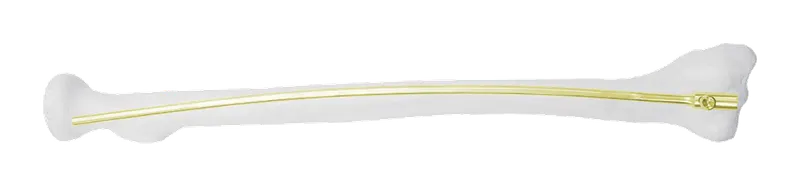
The Multiplanar Ulnar Intramedullary Nail System is a narrow, gently tapered shaft that follows the longitudinal path of the ulnar canal. Locking elements sit across multiple planes, so the locking orientation is planned with the construct rather than fixed in one direction. Seven lengths are catalogued, from 210 mm to 270 mm in 10 mm steps, each in a left and a right form and both diameters, for twenty-eight variants in all.
Radius intramedullary nails and the curve of the canal
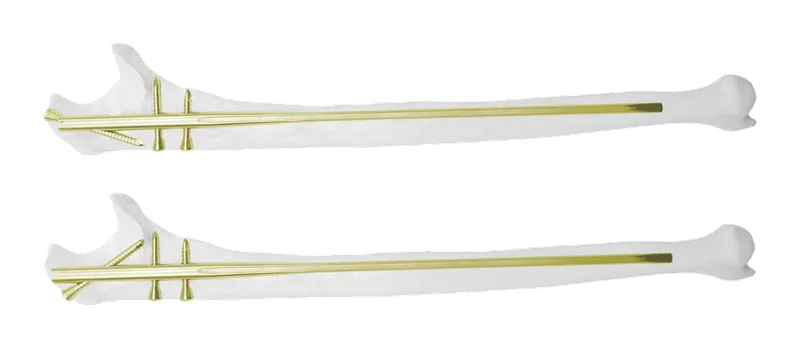
Kangli's Multiplanar Radial Intramedullary Nail System carries a subtle longitudinal curve corresponding to the changing direction of the radial canal, establishing a continuous path through the radial shaft. Terminal fixation features are grouped at the nail end, positioning the locking paths around the shaft. Five lengths run from 190 mm to 230 mm in 10 mm steps, again in left and right forms.
Matching ulna and radius nail systems
Where both forearm bones are instrumented, the two nails are ordered together as ulna and radius nail systems, each keeping its own geometry and side. The shared components are the Forearm Intramedullary Nail End Cap, listed as a flush 0 mm titanium alloy cap, and the Forearm Intramedullary Nail Locking Screw at 3.0 mm in diameter, catalogued from 10 mm to 60 mm in 2 mm increments. Request a Quote for the variant list.
FAQ
Frequently asked questions
Are the ulnar and the radial nail the same implant?
No, they are separate systems. The ulnar nail is a narrow, gently tapered shaft following the longitudinal path of the ulnar canal. The radial nail carries a subtle longitudinal curve corresponding to the changing direction of the radial canal, with its fixation features grouped at the nail end. Where both bones are instrumented, the two are ordered together.
What diameters and lengths are available?
Both nails are drawn at 3.0 mm and 3.5 mm. The ulnar system is catalogued in seven lengths from 210 mm to 270 mm in 10 mm steps, giving twenty-eight variants across the two sides and two diameters. The radial system is catalogued in five lengths from 190 mm to 230 mm in the same steps, giving twenty variants on the same basis.
Are the forearm nails supplied sterile?
Sterile packaging is the packaging form recorded against every variant on this page: both nail systems, the end cap and the locking screw. Material is titanium alloy throughout. Packaging form is recorded per variant in the catalogue, alongside diameter and length, so it can be confirmed for the exact size you intend to order.
Which screw and end cap fit these nails?
The Forearm Intramedullary Nail Locking Screw is listed at 3.0 mm in diameter, from 10 mm to 60 mm in 2 mm increments, in titanium alloy. The Forearm Intramedullary Nail End Cap is a single flush titanium alloy component at 0 mm. Both are catalogued on this page beside the ulnar and radial systems.
Are left and right versions catalogued?
Yes. Every length on both nails is listed in a left and a right form, so the side-specific option corresponds to the forearm being instrumented. On the radial nail this keeps the intended orientation of the curved shaft and its terminal fixation features. On the ulnar nail it maintains the designated locking orientation.
Can these nails be made to an OEM or ODM specification?
Yes. Kangli Orthopaedics has manufactured orthopaedic implants and instruments since 2002 and works on OEM, ODM and OBM terms, machining on 5-axis centres and Swiss-type lathes with an on-site vacuum furnace for stress relief and annealing. Send the diameters, lengths and packaging you need through Request a Quote.