

Humeral & Tibial Intramedullary Nails
Overview
Range overview
Two anatomies share this sub-catalog: the humeral shaft and the tibial shaft, both served by titanium alloy nails. Three systems are listed, one humeral and two tibial, each catalogued with the locking screws or end caps that complete it. Two of them lock across several planes; the third locks transversely near its separated ends.
Humeral intramedullary nails in left and right forms
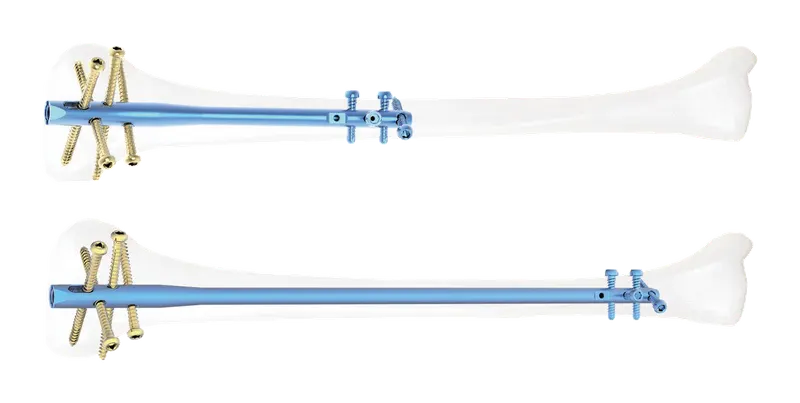
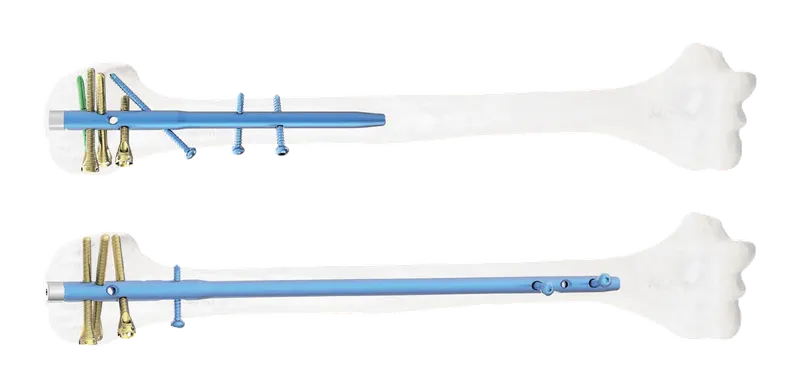
The Multiplanar Humeral Intramedullary Nail System is built on a cylindrical titanium alloy shaft with tapered transitions and rounded ends, listed in seven lengths from 160 mm to 300 mm, each in a left and a right version. Locking paths sit at varied orientations around the implant, which is what makes these multi-dimensional humeral nails rather than single-axis constructs. Two screw forms complete Kangli's humerus nailing systems: a Torx locking screw with a recessed drive, and a full-thread screw threaded along its working length.
Suprapatellar tibial nails and the approach they follow
Kangli's Multiplanar Suprapatellar Tibial Intramedullary Nail System sets its entry at the proximal tibia. Locking is distributed across several axes rather than one transverse direction, and the holding-type screw is a double-thread, full-thread design with a cancellous thread form for the metaphyseal segment; two thread starts advance it by two pitches per turn. End caps close the suprapatellar end in 0, 5, 10 and 15 mm lengths, in a plain and a locking form.
Tibial intramedullary nails with cannulated end caps
The Tibial Intramedullary Nail System is the straight long nail of the pair, offered in 8.4, 9.0 and 10 mm diameters and nine lengths from 255 mm to 375 mm. Transverse locking positions near its separated ends make it one of two tibial interlocking nails catalogued here. Two cannulated end caps finish these cannulated tibial nails: a normal closure, and a locking version that engages the terminal interface. Request a Quote for the full variant list.
FAQ
Frequently asked questions
Which systems are listed under humerus and tibia?
Three. The Multiplanar Humeral Intramedullary Nail System covers the humeral shaft. The Multiplanar Suprapatellar Tibial Intramedullary Nail System and the Tibial Intramedullary Nail System cover the tibial shaft, the first entered at the proximal tibia through a suprapatellar route, the second a straight long nail locked near its separated ends. All three are titanium alloy.
Is the humeral nail available for both arms?
Yes. It is catalogued in a left and a right version at every length, across seven lengths from 160 mm to 300 mm, so the sided locking orientation is kept. Thirty-five variants are listed in total, including the Torx locking screw and the full-thread locking screw supplied with the system.
What is the difference between the two tibial nails?
The suprapatellar system sets its entry at the proximal tibia and spreads locking across several axes, with forty-seven variants including holding-type and multi-dimensional full-thread locking screws. The straight system is a plain long nail with transverse locking near its separated ends, catalogued in three diameters and nine lengths from 255 mm to 375 mm with two cannulated end caps.
What thread forms are on the tibial locking screws?
The full-thread locking screw carries thread along its whole working shaft rather than leaving a smooth central section. The holding-type version puts a cancellous thread form on that same shaft, a coarser and deeper profile shaped for cancellous bone. It is also cut as a double thread, with two thread starts, so each turn of the driver advances it by two pitches.
What end cap lengths are supplied?
End caps for the suprapatellar tibial system are catalogued at 0, 5, 10 and 15 mm, in a cap that closes the suprapatellar end and a locking cap that engages the terminal locking interface. The straight tibial nail takes either a cannulated normal end cap or a cannulated locking end cap.
Do you supply these nails under OEM or ODM?
Yes. Kangli Orthopaedics has manufactured orthopaedic implants and instruments since 2002 and works on OEM, ODM and OBM terms from a single campus, machining nail bodies and screws on 5-axis centres and Swiss-type lathes. Send the systems, diameters and lengths you need through Request a Quote.