

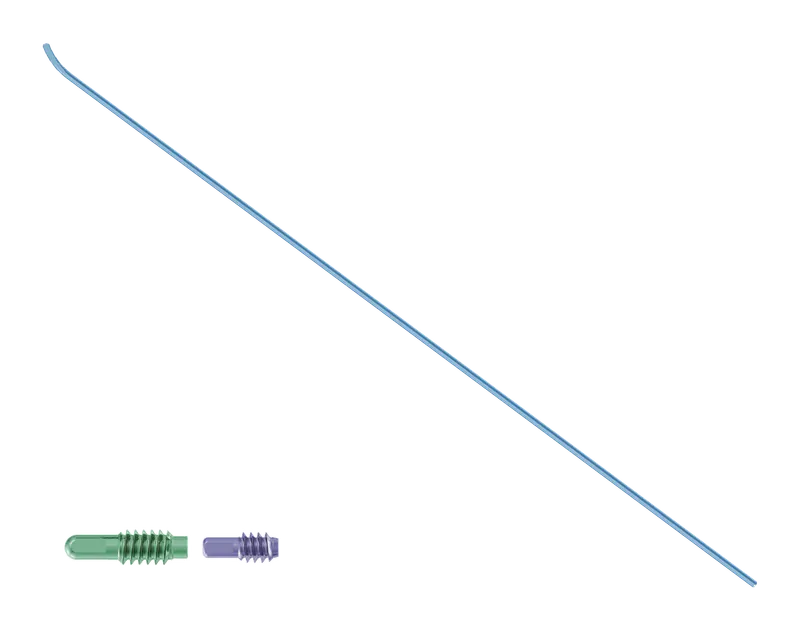
Elastic Stable Intramedullary Nails
Overview
Range overview
Elastic stable intramedullary nails form the flexible half of Kangli Orthopaedics' nailing catalogue: a slender titanium alloy shaft placed along the medullary canal of a pediatric long bone, rather than a rigid body locked by transverse screws. One system is listed here, in five diameters and two lengths, with a threaded end cap as its companion component. Every variant is supplied in sterile packaging.
The shape of the titanium elastic nails
The shaft is narrow and cylindrical, with a gentle bend and an elastic profile for insertion along the planned intramedullary route. Titanium alloy forms the pin body and gives a consistent cylindrical surface for handling and placement, continuous along the portion that sits within the canal. The nail is catalogued without transverse locking screws of its own.
Diameters and lengths for pediatric bone segments
Five diameters are catalogued: 2.0, 2.5, 3.0, 3.5 and 4.0 mm. Two nail lengths are listed, 320 mm and 400 mm, and the range is divided into Mini and Large specifications, for eight variants in all. Selection is by canal and bone segment, so a dimension is chosen for the intended fixation site rather than a single standard size being applied to every case.
Elastic intramedullary pins and their end cap
The Metal Intramedullary Pin End Cap is the companion component, a compact threaded design that engages the nail end where a terminal closure is specified. Fitted, it establishes a defined endpoint for the assembly.
Flexible nailing systems made to order
Kangli has manufactured orthopaedic implants and instruments since 2002, machining pin bodies on 5-axis and Swiss-type equipment on a single campus of around 200 staff, and works on OEM, ODM and OBM terms. It sells directly into 35 countries. Request a Quote for diameters, lengths and packaging detail.
FAQ
Frequently asked questions
What sizes does the elastic nail come in?
Five diameters are catalogued: 2.0, 2.5, 3.0, 3.5 and 4.0 mm. Two nail lengths are listed, 320 mm and 400 mm, and the range is divided into Mini and Large specifications, giving eight variants in total. Selection is made against the canal and the bone segment being fixed, rather than from one standard size applied to every case.
What is the nail made from?
Titanium alloy. It forms the pin body and gives a consistent cylindrical surface for handling and placement, continuous along the portion positioned within the medullary canal. The companion Metal Intramedullary Pin End Cap is titanium alloy as well, and is catalogued with the nail on this page rather than ordered from a separate range.
How does an elastic nail differ from a locked nail?
The elastic nail is slender and springy, placed along the medullary canal and catalogued without transverse locking screws, where a rigid nail is locked transversely by screws through the bone. This page lists the flexible format only; the locked systems sit in the other sub-catalogs of the nail range.
Is the end cap required?
No, it is a companion component. The Metal Intramedullary Pin End Cap has a compact threaded design that engages the nail end where a defined terminal closure is specified, and once fitted it establishes an endpoint for the assembly. Where no terminal closure is planned, the nail is ordered on its own.
Are the nails supplied sterile?
Sterile packaging is the packaging form recorded against every variant on this page. Diameter, length, specification and material are recorded per variant alongside it, so a given size can be confirmed before an order is placed. Ask for the current variant listing through Request a Quote.
Can Kangli manufacture elastic nails to our specification?
Yes. Kangli Orthopaedics has manufactured orthopaedic implants and instruments since 2002, with around 200 staff, and works on OEM, ODM and OBM terms. Machining is on 5-axis centres and Swiss-type lathes, with an on-site vacuum furnace for stress relief and annealing. Its R&D work covers 3D printing and personalised implants.