

Femoral Intramedullary Nails
Overview
Range overview
Femoral intramedullary nails on this page cover four titanium alloy systems, from a retrograde shaft nail through two gamma nail families to a femoral locking component set. Between them they carry more than 170 catalogued variants, with nail body, screws and end cap specified together as one assembly. Nail bodies are listed at 9.4, 10, 10.5, 11 and 12 mm, with screws in their own diameters, and shaft lengths reach 420 mm.
Sliding compression gamma nails for the proximal femur
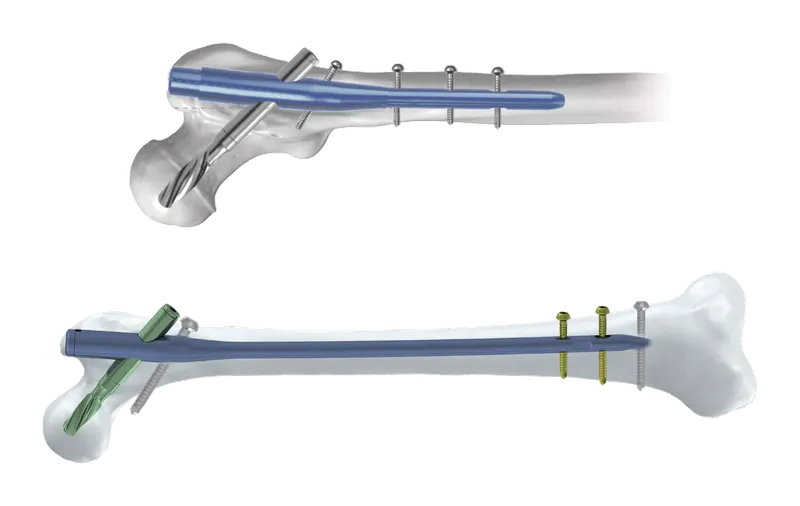
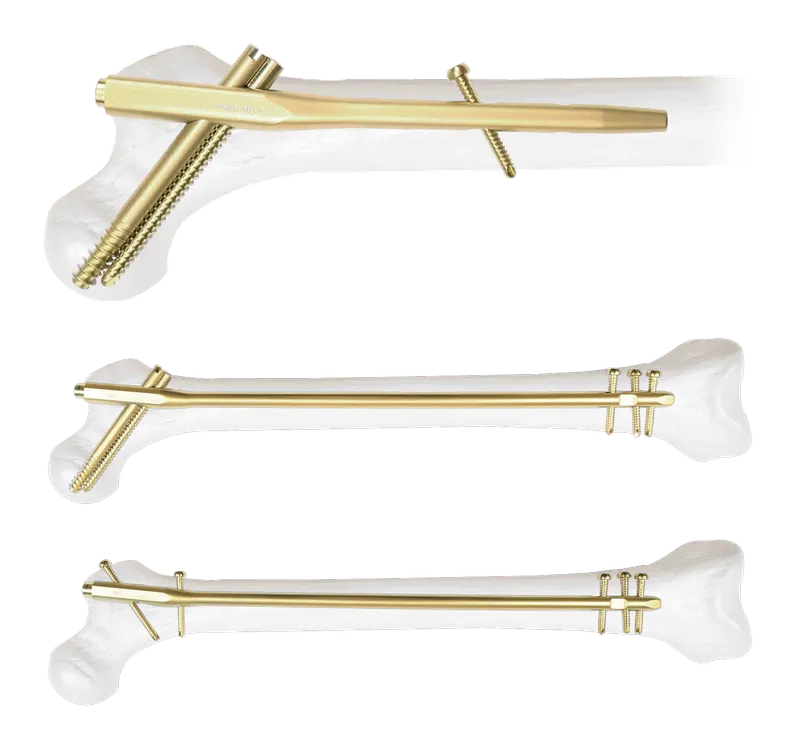
The Sliding Compression Gamma Nail System pairs a parent screw with a sliding lag screw and is drawn with a 5° lateral offset, aligning the insertion axis with an entry at the greater trochanter. Its proximal body carries a trapezoid cross-section, and the proximal screw path sits at 127° to the shaft. Small formats, an Asian Version and an Enhanced Edition, reduce the proximal diameter so the nail's widest part occupies less of the canal. Two locking screws are completed through one incision on the 180 mm nail, and a distal locking slot is among the options. It is supplied in left and right forms.
PFNA gamma nails and the blade construct
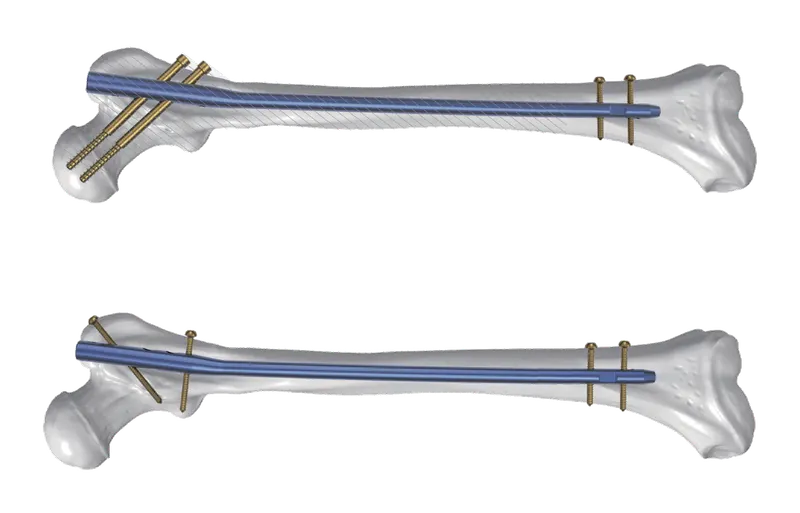
In the Blade Gamma Nail System, a PFNA blade is the proximal element, passing through the proximal femur into an enhanced main nail. Both gamma families are proximal femoral nails, take a locking or a normal end cap in flush, 5, 10 and 15 mm lengths, and are identified left and right for the operative side.
Reverse locking femoral nails and shaft components
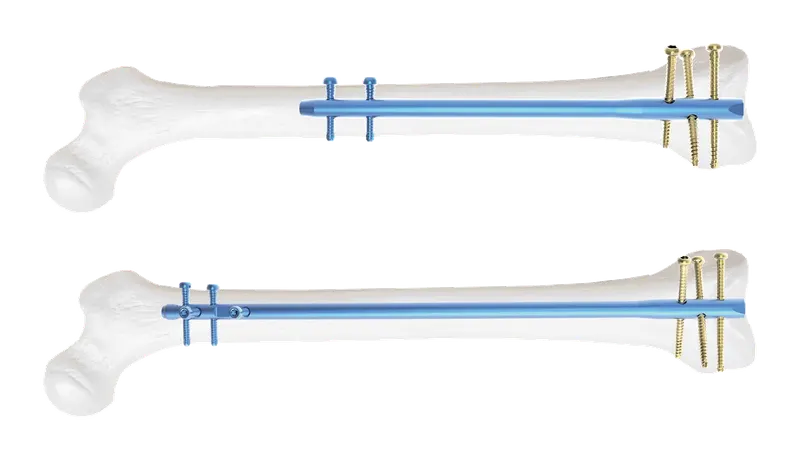
The Multiplanar Retrograde Femoral Intramedullary Nail System is configured for retrograde passage through the femur, with locking trajectories in several planes and double-thread screws that seat in fewer turns. The Femoral Intramedullary Nail System adds a cannulated anti-rotation screw, a full-thread locking screw shared with tibial nails, and a femoral locking nail end cap. Request a Quote for the configuration list.
FAQ
Frequently asked questions
What is the difference between the two gamma nail systems?
The Sliding Compression Gamma Nail System is built around a paired screw construct: a parent screw with a sliding lag screw that travels in relation to it. The Blade Gamma Nail System replaces that pair with a PFNA blade, which passes through the proximal femur into an enhanced main nail. Both are catalogued with their own end caps and side-specific configurations.
Which of the femoral nails are sided?
The sliding compression gamma nail is supplied in left and right forms, and the blade gamma nail is catalogued in right- and left-specific configurations that identify the operative side. The retrograde femoral system and the femoral locking component set are listed by diameter, length and component type rather than by side.
What lengths does the retrograde femoral system cover?
The Multiplanar Retrograde Femoral Intramedullary Nail System is catalogued in nine lengths between 180 mm and 400 mm, at 9.4, 10 and 11 mm diameters, in titanium alloy. Its end caps come in four lengths, from flush to 15 mm, in a locking form and a plain form. Thirty-two variants are listed in total.
How is distal locking arranged on the gamma nail?
Distal locking is not restricted to a single fixed hole. A distal locking slot is among the options, so the distal construct is selected from what the nail offers rather than being determined by one geometry. Locking is arranged so that two locking screws are completed through one incision on the 180 mm nail, and the holding-type full-thread screws cross the nail in more than one plane.
Why are small formats listed beside the standard gamma nail?
The small formats reduce the proximal diameter relative to the standard body, so the proximal end occupies less of the medullary canal at the widest part of the nail. That sizing is why the range appears in both standard and small forms rather than in one universal size. The small nails are catalogued as an Asian Version and an Enhanced Edition.
Can these systems be produced under OEM or ODM?
Yes. Kangli Orthopaedics machines its own nail bodies, lag screws, locking screws and end caps, and works with partners on OEM, ODM and OBM terms. Machining is done on 5-axis centres and Swiss-type lathes, with an on-site vacuum furnace for stress relief and annealing. Send the configuration you need through Request a Quote.