


Distal Tibia Locking Plates
Overview
Range overview
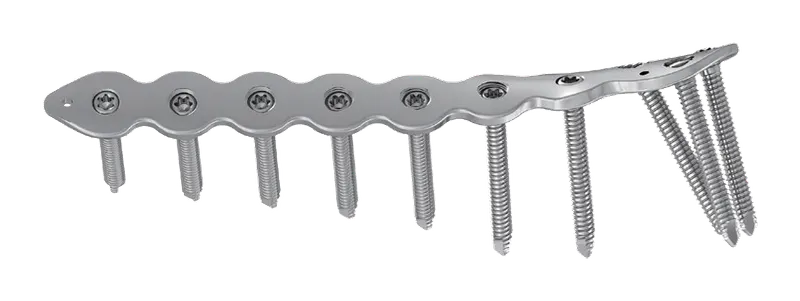
Kangli Orthopaedics machines its distal tibia locking plates from pure titanium in five contours: a lateral reconstruction profile, a posterior malleolar plate, a medial plate, and anterolateral and anteromedial forms. Each plate is chosen by the approach, not reshaped to suit it. All five take compatible locking screws, and on the lateral plate the seats are threaded so the head couples to the plate itself. Most are catalogued as separate left and right parts.
Distal lateral tibial reconstruction plates
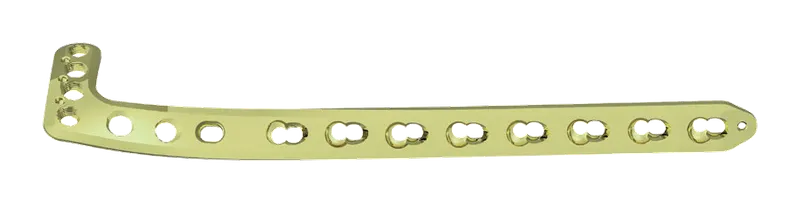
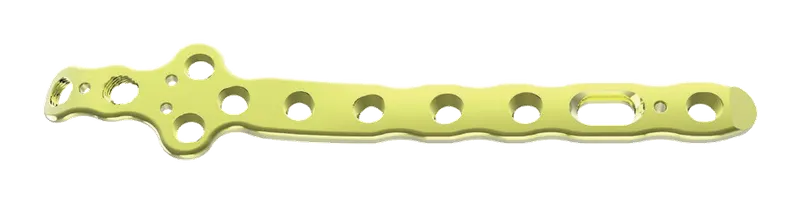
The lateral plate opens on a broad rounded end, runs through a gently undulating body and narrows into an upturned section, with concave scallops along the lower edge near the fixation positions. That reconstruction-oriented outline traces the lateral distal tibia from its broad ankle-side region into the shaft. Twenty-six variants are catalogued, in odd hole counts and in both sided and non-sided forms.
Anterior and medial ankle fracture fixation plates
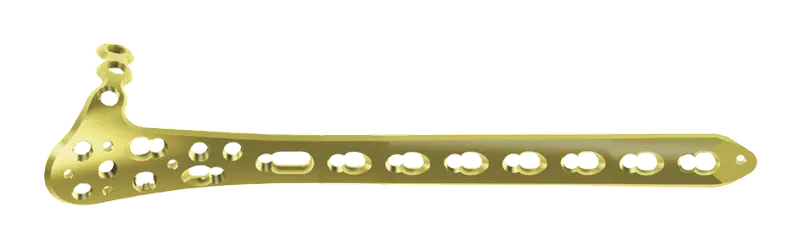
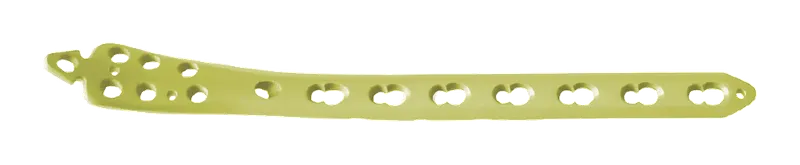
A short head that widens and angles upward from the shaft marks the anterolateral plate, which mixes circular, oval and paired-lobed apertures along its length across ten variants in odd hole counts from 5 to 13, left and right. The anteromedial plate flares into an irregularly triangular head with a raised extension on its upper edge, and its ten variants run even hole counts from 4 to 12. The medial plate sets waisted, double-lobed apertures in a single row behind a cluster of circular holes, across twenty variants and ten lengths.
The posterior malleolar plate
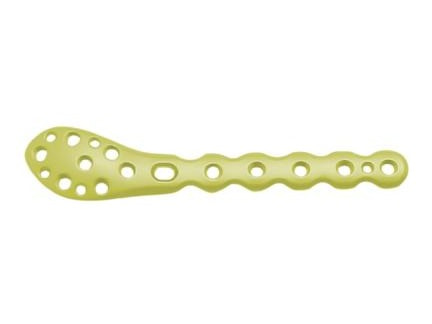
Circular and oblong openings cluster around the broad distal section of the malleolar plate, angled so the fragment zone can be approached from more than one trajectory. Four variants are listed, in four- and six-hole forms at 66, 86, 88 and 111 mm. Across these ankle plating systems one pattern holds: a contoured head at the joint end, an extended shaft along the tibia. Request a Quote for the variant tables.
FAQ
Frequently asked questions
Which approaches to the distal tibia does this range cover?
Five, each with its own plate: a lateral reconstruction contour for the lateral distal tibia, an anterolateral and an anteromedial plate for the anterior aspect, a medial plate running from the malleolar region along the shaft, and a posterior malleolar plate whose openings cluster around the distal end. All five are listed as distinct implants rather than one plate bent to suit.
What material are these ankle plates made from?
All five designs are machined from pure titanium. The material is constant across every variant of every plate here, so selection turns on contour, side, hole count and length rather than on alloy. On the lateral reconstruction plate the screw seats are threaded, coupling each seated screw head to the plate rather than clamping it against a smooth surface; all five take compatible locking screws.
Are left and right plates available?
The anterolateral, anteromedial and medial plates are catalogued only as side-specific parts, in matched left and right forms. The lateral reconstruction plate is listed both as side-specific versions and as non-sided ones. Because the upturned terminal section and the asymmetric edges follow one side of the tibia, the sided plates cannot be substituted for one another.
What hole counts and lengths are catalogued?
The anterolateral plate covers odd hole counts of 5, 7, 9, 11 and 13 at 123, 155, 187, 219 and 251 mm. The anteromedial plate covers 4, 6, 8, 10 and 12 holes at 115, 143, 171, 199 and 227 mm. The malleolar plate is listed in four- and six-hole forms at 66, 86, 88 and 111 mm, and the medial plate across twenty variants and ten lengths.
Which plate is intended for a posterior malleolar fragment?
The malleolar plate. Its broad distal section gathers circular and oblong openings around the terminal contour, and the openings near the tip are oriented in different directions so that fixation points within the uneven malleolar region can be approached from separate trajectories. The clustered head then transitions into an elongated shaft that continues the fixation line along the distal tibia.
Can these plates be produced to our own specification?
Yes. Kangli Orthopaedics has manufactured orthopaedic implants and instruments since 2002 and works on OEM, ODM and OBM terms, from production to a customer's drawings through to a geometry developed jointly and supplied under the customer's brand. CNC turning and milling and an on-site vacuum heat-treatment furnace keep machining and stress relief on a single campus.