

Calcaneal Locking Plates
Overview
Range overview
Four designs make up the calcaneus and hindfoot sub-catalogue, all machined from pure titanium and all supplied in left and right forms. One follows the calcaneal body through a lobe-and-bridge outline; the other three take narrower routes across particular parts of the bone, as a branched combined plate, a serpentine posterior plate for the tuberosity and a two-lobed anterior plate for the calcaneal process.
Anatomical calcaneal locking plates
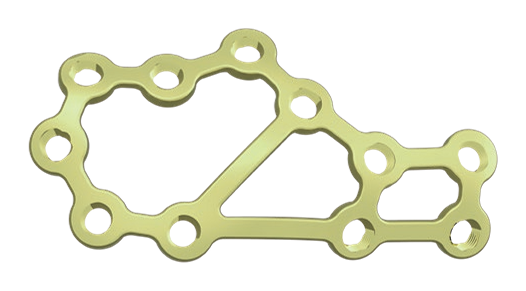
Width changes along the anatomical plate, which runs from a broad, irregular end through a narrower waist into a shaped tail rather than holding a constant strip. Diagonal, horizontal and angled bridges connect its regions while keeping material around each opening and leaving the intervening area visible. Thirteen variants are listed under two configurations, a principal plate and a short-tail version, in hole counts of 8, 10, 11, 12 and 13 and eight lengths between 49 mm and 71 mm.
Minimally invasive calcaneal plates
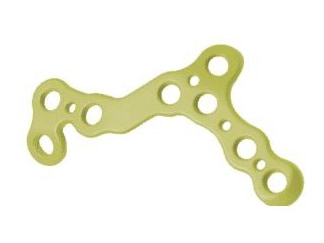
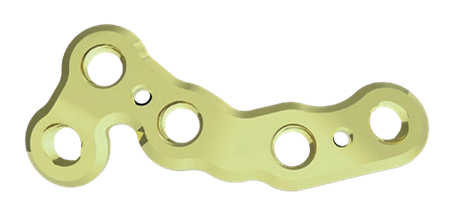
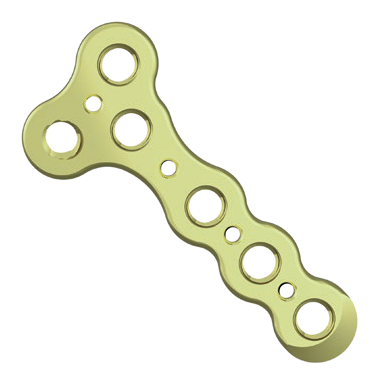
Three narrower profiles cover the rest of the bone. The combined plate splits into an upper and a descending lower branch either side of a narrow waist and ends in a downward hook carrying its own aperture, in eight- and nine-hole left and right forms across six variants. The posterior plate runs a serpentine line of rounded lobes and connecting waists along the calcaneal tuberosity, in five- and six-hole forms across four variants. The anterior plate opens on two compact lobes over the calcaneal process, then narrows through a shallow waist into a curved body, in five-hole left and right forms.
Screw seating across the calcaneal fracture plates
On the anatomical plate, rounded and chamfered rims surround the openings and form a seat that holds a compatible locking screw head within the plate face. The posterior tuberosity plate carries raised or beveled aperture rims and a gently beveled perimeter, keeping its profile thin. Request a Quote for the variant tables and part lists.
FAQ
Frequently asked questions
How many calcaneal plate designs are in this range?
Four. An anatomical plate that follows the calcaneal body, a combined plate whose apertures split across an upper and a lower branch, a posterior plate that runs along the calcaneal tuberosity, and an anterior plate for the calcaneal process. The anatomical plate is itself listed in two configurations, a principal plate and a short-tail version, across thirteen variants.
What material are the calcaneal plates made from?
Every plate in this sub-catalogue is machined from pure titanium, and the material does not change between variants of a listing. Selection turns instead on the contour, the side, the hole count and, on the anatomical plate, the length. On the anatomical plate the openings are recessed and chamfered so a compatible locking screw head sits within the plate face.
Do the minimally invasive plates come in left and right forms?
All three do, and so does the anatomical plate. The combined plate is listed in eight- and nine-hole left and right forms, the posterior tuberosity plate in five- and six-hole forms, and the anterior process plate in a five-hole form. Because the branches, hook and lobes are oriented for one side of the calcaneus, the parts are not interchangeable.
Do you supply subtalar joint cannulated screws with these plates?
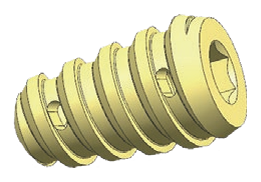
Not from this sub-catalogue, which lists plates only. Screw fixation for the foot and ankle, including a screw for subtalar joint stabilization, is catalogued separately in the screws sub-catalogue of the same family. Naming both sub-catalogues in one enquiry lets the plate and screw sides of a construct be quoted together.
What hole counts are available on the anatomical plate?
Hole counts of 8, 10, 11, 12 and 13 are listed, with the eleven-hole plate also catalogued in explicit left and right parts. Thirteen variants cover those counts across the principal plate and the short-tail version, in eight lengths between 49 mm and 71 mm. The short tail is the option where a shorter terminal reach is wanted.
Can calcaneal plates be manufactured to our drawing?
Yes. Kangli Orthopaedics has manufactured orthopaedic implants and instruments since 2002 and takes OEM, ODM and OBM work, from production to a customer's drawings through to a geometry developed together and supplied under the customer's own brand. Five-axis machining centres, Swiss-type lathes and an on-site vacuum heat-treatment furnace keep cutting and stress relief on one campus.