

Clavicle Locking Plates
Overview
Range overview
Kangli Orthopaedics manufactures clavicle locking plates in two profiles, both machined from pure titanium and both supplied in matched left and right forms. One follows the bone; the other reaches beneath it. Between them they cover midshaft and distal fixation across twenty-six catalogued variants, and the choice turns on where the fracture line sits.
Clavicle hook plates for the distal segment
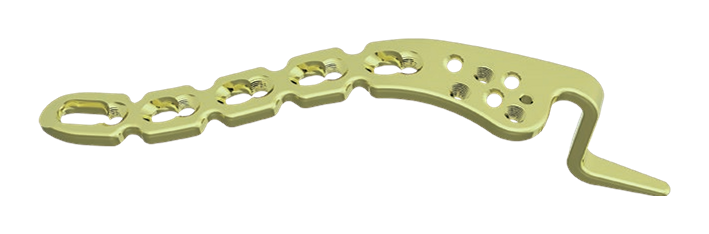
The clavicular hook plate carries a shallow curve along its body and an integrated hook that turns down and outward from the broad distal end, so the engagement point sits beneath the distal clavicle without a separate component. Elongated slots run through the narrower section and let the plate be translated before the screws are tightened, while circular and oval locking openings are grouped across the broad end. Sixteen variants cover hole counts of 8, 9, 10 and 11 in left and right, two heights of 14 mm and 17 mm, and four lengths from 54 mm to 92 mm.
The S-shaped plate for midshaft fixation
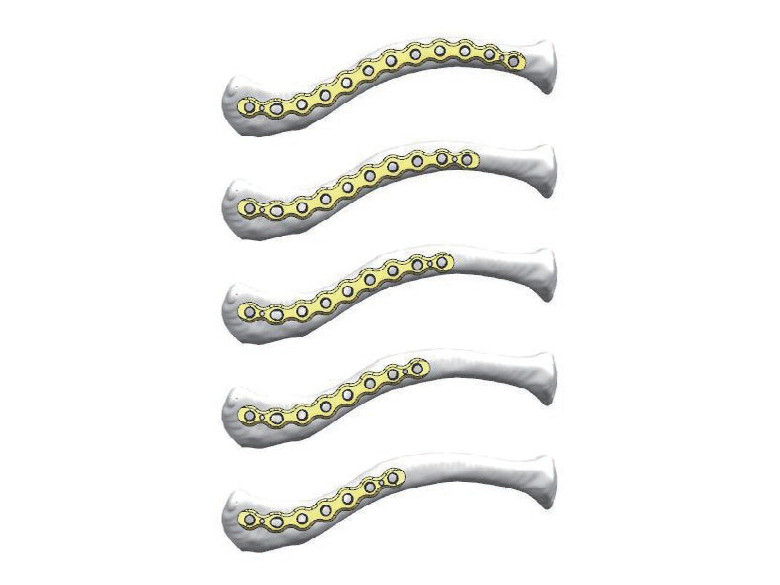
Where the plan calls for a plate that follows the clavicle rather than extending beneath it, the S-shaped low-stress plate distributes its change of direction through a gradual double curve instead of one concentrated bend. Each circular opening takes a locking screw, giving a defined plate-and-screw connection at every position along the shaft. Ten variants cover five hole counts — 7, 8, 9, 10 and 12 — in left and right, at lengths of 91, 102, 113, 123 and 145 mm.
Clavicle fracture plates on OEM and ODM terms
Both designs are machined in-house on five-axis equipment and stress-relieved in an on-site vacuum furnace. Kangli has manufactured orthopaedic implants since 2002 and works on OEM, ODM and OBM terms, so clavicle fracture plates can be produced to a partner's drawings or branded for a distributor's catalogue. For the full size table, request a quote.
FAQ
Frequently asked questions
What is the difference between the hook plate and the S-shaped plate?
The hook plate carries an integrated hook that turns down and outward from its broad end, so the engagement point sits beneath the distal clavicle. The S-shaped plate stays on the bone, following the clavicle through a gradual double curve rather than reaching under it. Both are listed for midshaft and distal fixation; the choice follows where the fracture line sits.
Are both plates supplied in left and right forms?
Yes. Every variant of both designs is sided. The hook plate is catalogued as 8L and 8R, 9L and 9R, 10L and 10R, 11L and 11R. The S-shaped plate is catalogued as 7L and 7R, 8L and 8R, 9L and 9R, 10L and 10R, 12L and 12R. An order names the side as well as the hole count.
What lengths and hole counts are available?
The hook plate covers four lengths — 54, 66, 79 and 92 mm — in two heights, 14 mm and 17 mm, across four hole counts from 8 to 11, giving sixteen variants. The S-shaped plate covers five lengths — 91, 102, 113, 123 and 145 mm — across five hole counts of 7, 8, 9, 10 and 12, giving ten variants.
What material are the plates machined from?
Both designs are pure titanium throughout, with no alloy or polymer components in the plate itself. They are machined at Kangli's own works in Suzhou on five-axis equipment and stress-relieved in an on-site vacuum furnace. Material is stated on each product page and does not vary between the sided forms or across the length range.
Can these plates be produced under OEM or ODM?
Yes. Kangli is a manufacturer, founded in 2002, with around 200 staff on a 50-acre campus, and it runs OEM, ODM and OBM programmes for orthopaedic implants and instruments. A partner can have either clavicle profile made to its own drawings, or take the catalogued geometry under its own brand. Devices reach more than 40 countries.