

Intramedullary Nails
Overview
Range overview
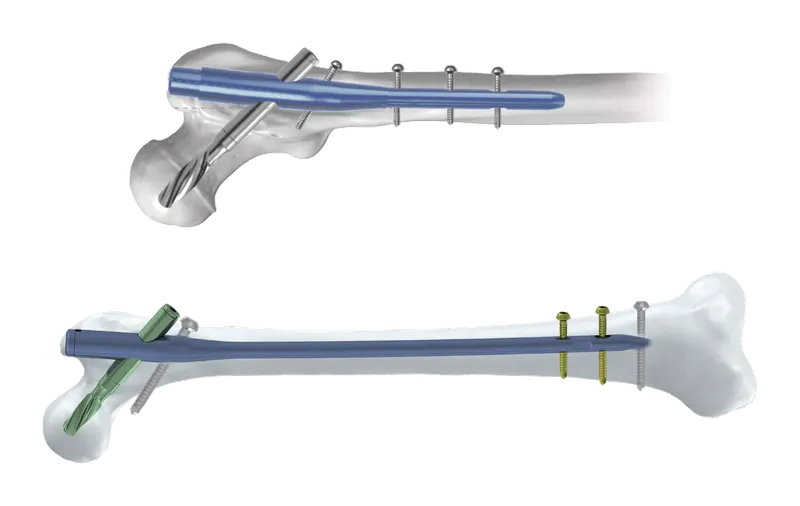
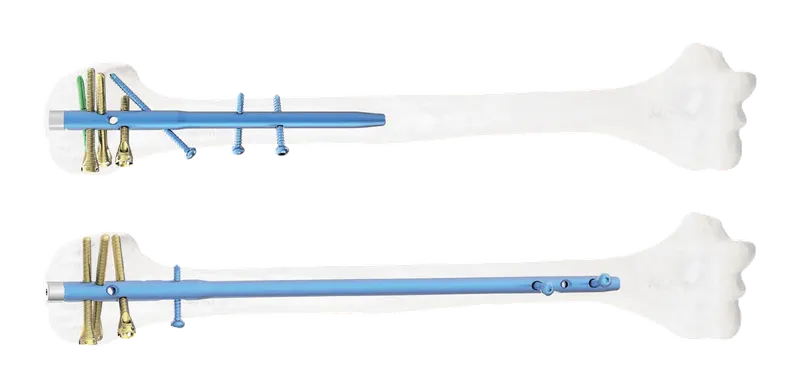
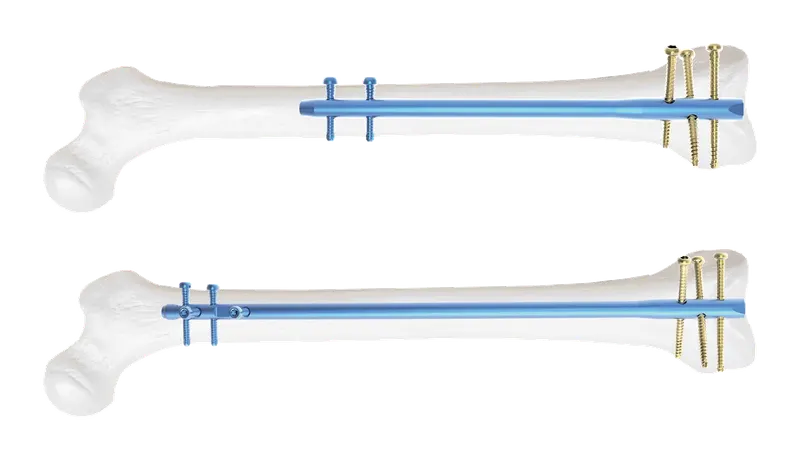
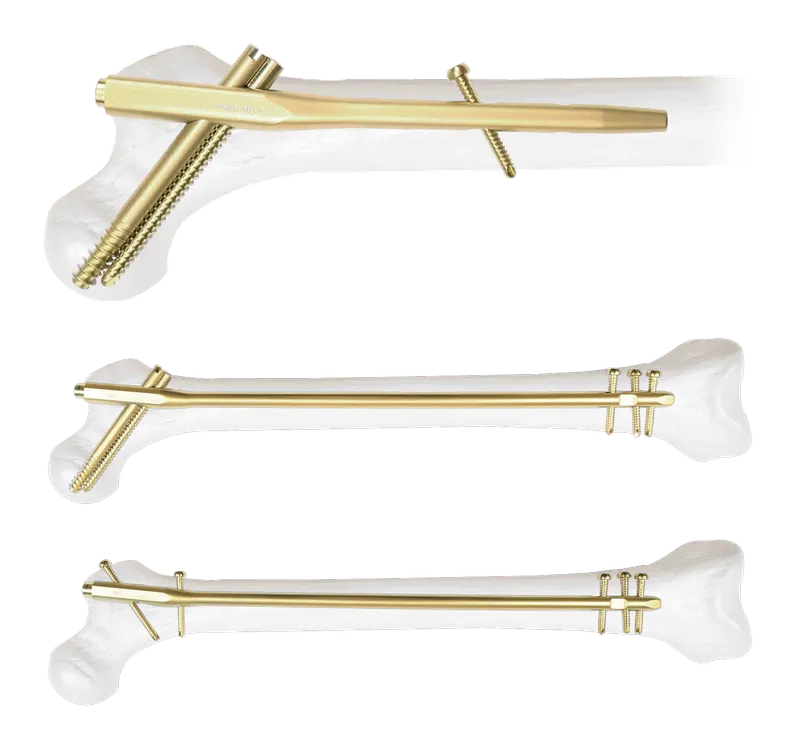
Kangli Orthopaedics manufactures intramedullary nails in titanium alloy for long-bone fixation in the upper and lower limbs. The range is arranged in four sub-catalogs — Femur & Hip, Humerus & Tibia, Forearm and Pediatric — and systems are catalogued as assemblies rather than as bare nails: the nail body, the screws that lock it and the cap that closes its end. Several systems are drawn in left and right forms and listed across a span of diameters and lengths, so a construct is matched to the bone being instrumented rather than to one standard size.
What the interlocking nail systems have in common
Most nails here lock in more than one plane. Multiplanar locking places screw paths at differing orientations around the implant, so the locking direction is chosen with the construct rather than fixed by a single transverse hole. Locking screws are drawn in several forms — full-thread, Torx-drive, double-thread, and holding types that stay on the driver. A double-thread screw advances two pitches per turn, reaching its seated depth in fewer turns than a single-start thread.
Cannulated locking nails, end caps and screw sets
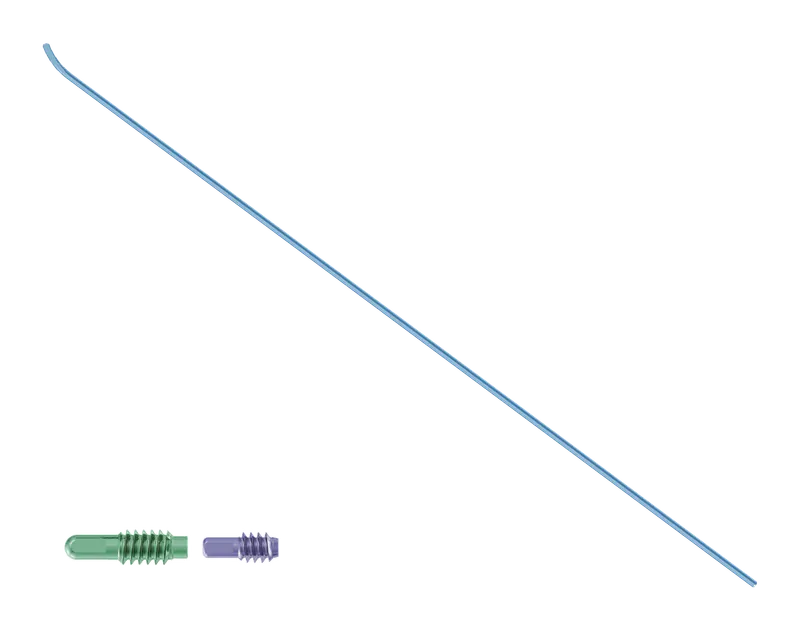
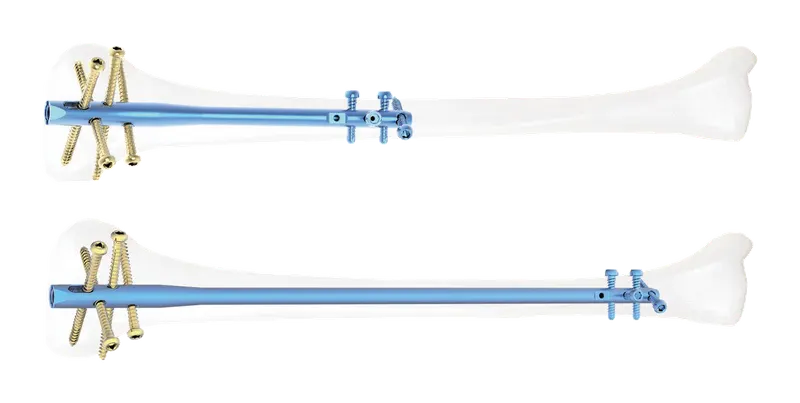
Terminal components are catalogued with the nails they close. End caps are listed in flush, 5 mm, 10 mm and 15 mm lengths, in a locking form that engages the nail's terminal interface and a plain form that closes it without locking. Cannulated parts run through the range, from the cannulated anti-rotation screw in the femoral assembly to the cannulated end caps on the straight tibial nail.
Ordering from an intramedullary nail manufacturer
Kangli has built orthopaedic implants and instruments since 2002 on a single campus, machining nail bodies and screws on 5-axis and Swiss-type equipment, and offers OEM, ODM and OBM programmes on its orthopedic nailing systems. Its devices reach more than 40 countries. Request a Quote for the sub-catalog you need.
FAQ
Frequently asked questions
Which bones does Kangli's intramedullary nail range cover?
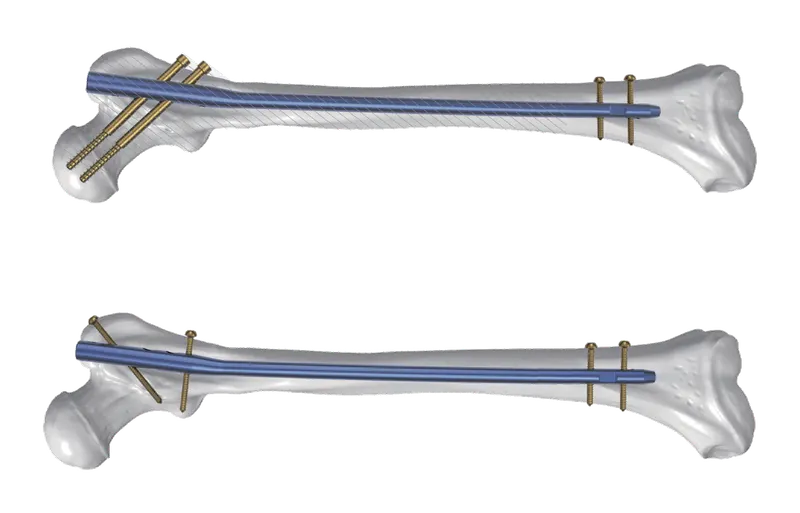
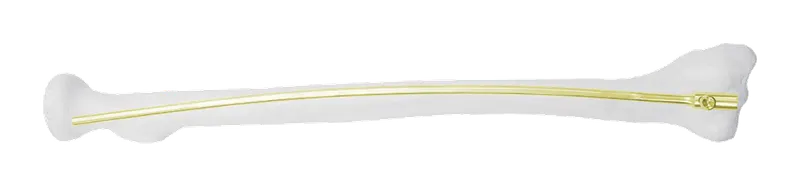
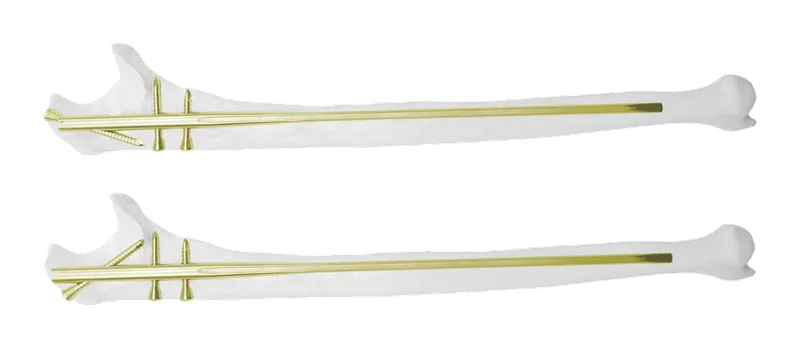
The catalogue is split into four sub-catalogs. Femur & Hip holds the retrograde femoral nail, two gamma nail families and a femoral locking component set. Humerus & Tibia holds one humeral system and two tibial ones. Forearm holds separate nails for the ulna and the radius. Pediatric holds the flexible nail for pediatric long bones. Every nail body is titanium alloy.
Are the nails supplied in left and right versions?
Several are. The sliding compression gamma nail, the blade gamma nail, the multiplanar humeral nail and both forearm nails are catalogued with a left and a right form, so the sided geometry and locking orientation are kept intact. The straight tibial nail and the pediatric nail are not sided, and are ordered by diameter and length alone.
What end cap options are listed with the nails?
End caps appear across the femoral, tibial and forearm systems in two roles: a locking cap that engages the nail's terminal interface, and a normal cap that closes the end without locking. Cap lengths are catalogued at 0, 5, 10 and 15 mm, so the terminal finish is chosen with the assembly. The forearm cap is listed flush at 0 mm.
What locking screw forms are available across the range?
Full-thread screws carry thread along the whole working shaft instead of leaving a smooth central section. Torx-drive screws use a recessed drive matched to their driver. Holding-type screws stay on the driver rather than sitting loose on its tip, and several are cut with a double thread, which advances the screw two pitches per turn and shortens the insertion step at each locking site.
Does Kangli offer OEM and ODM on its nailing systems?
Yes. Kangli Orthopaedics has manufactured orthopaedic implants and instruments since 2002 and works on OEM, ODM and OBM terms, with around 200 staff on a single 50-acre campus. Nail bodies, screws and end caps are machined in house on 5-axis centres and Swiss-type lathes, with a vacuum heat-treatment furnace on site for stress relief and annealing.
How do I get the full variant list for a nail system?
Open the sub-catalog for the anatomy you need, then the product page, where diameters, lengths, materials and component types are listed per variant. Send the systems and sizes you are interested in through Request a Quote, and Kangli's sales team will come back with the catalogue detail for that configuration.