Femoral Locking Plates
Range overview
Kangli Orthopaedics manufactures femoral locking plates in pure titanium for the femur and hip, gathered here as eight plate families. The range runs from the proximal femur and the femoral neck, through the shaft, to both sides of the distal femur, and it includes a plate contoured for fixation around an existing femoral prosthesis. Several families are supplied in left and right forms, with hole counts and lengths catalogued variant by variant.
Proximal femoral locking plates and DHS constructs
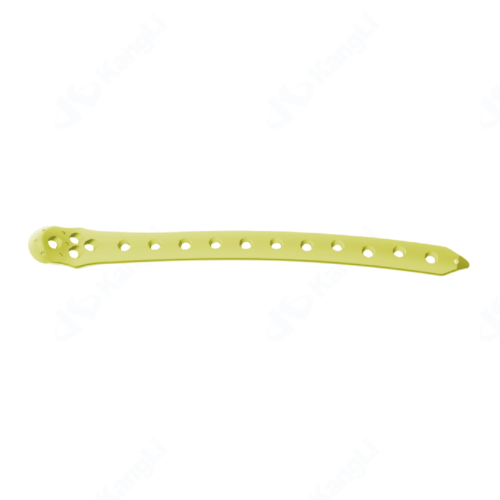
The Proximal Femoral Locking Plate sets a broadened proximal head against a slim shaft and runs to 26 catalogued variants. The DHS Locking Plate with Lag Screw carries a cylindrical barrel for the lag screw, in four hole counts of 4, 5, 6 and 8 at 125, 146, 165 and 203 mm. Distributors cataloguing DHS hip plates beside a rod-based option will also find the Hip Locking Compression Plate System, which pairs its plate with an FNS Dynamic Rod and an FNS Antirotation Screw in pure titanium or titanium alloy.
Distal femur plates for the lateral and medial sides
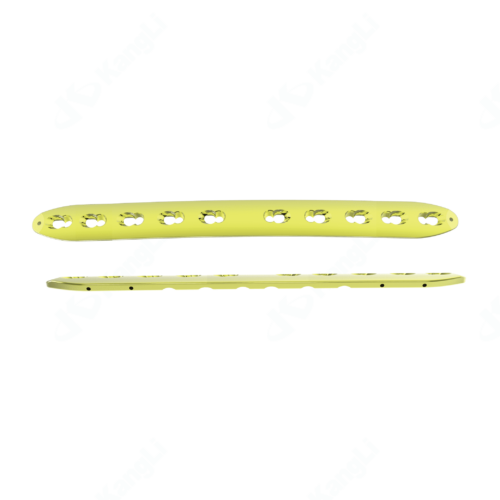
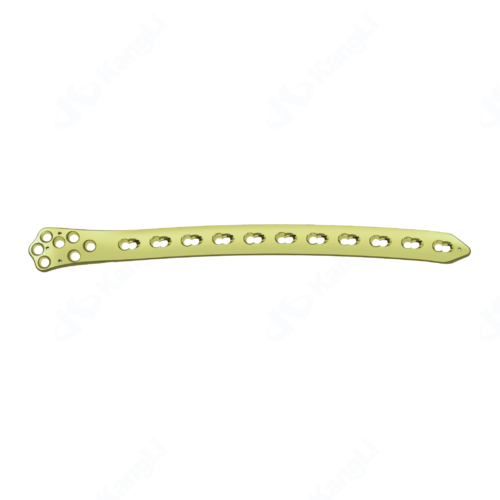
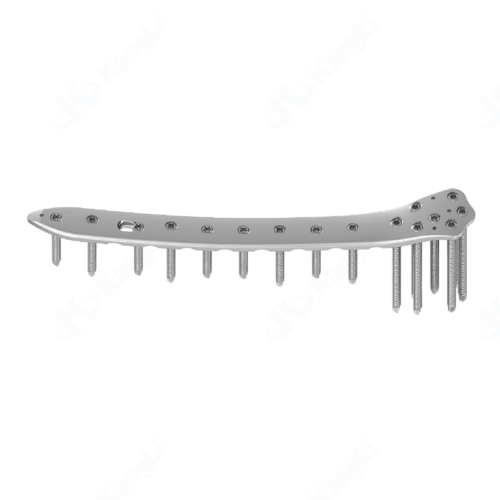
Staggered apertures spread across the condylar region on the Distal Femoral Lateral Locking Plate, which then continues along the shaft in five lengths between 178 mm and 353 mm, in five, seven, nine, eleven and thirteen holes, each left and right. Its medial counterpart uses a lobed distal end over 79 mm and 111 mm bodies in five- and seven-hole forms.
Femoral neck systems and periprosthetic revision
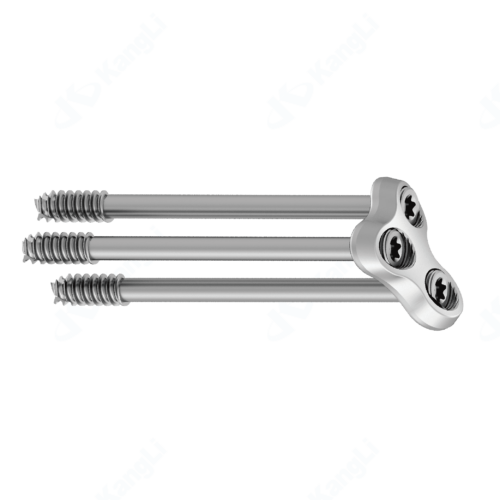
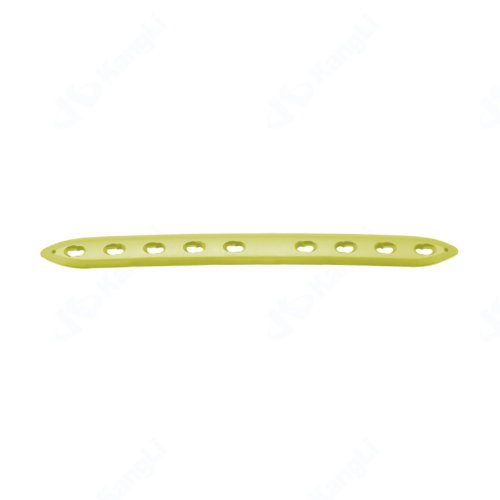
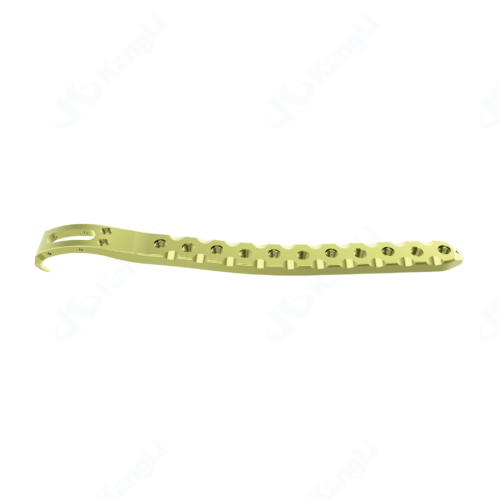
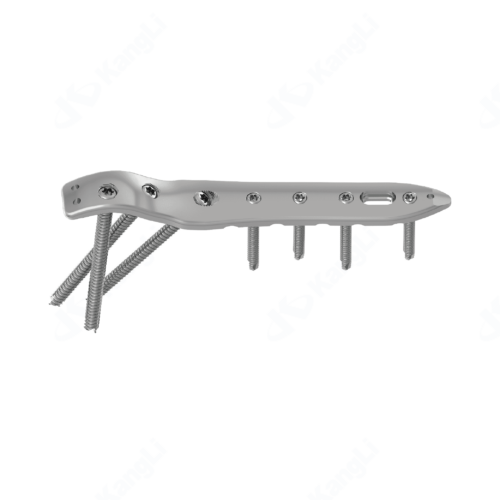
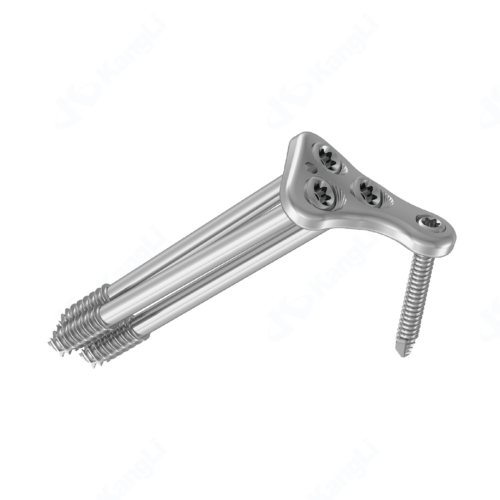
Under a rounded triangular head with a terminal tab, the Femoral Neck Locking Plate groups substantially parallel proximal screws, in large-hole and small-hole builds. The Femoral Periprosthetic Revision Locking Plate instead carries a shallow longitudinal bow, an oval positioning slot and scalloped edge relief across nine variants. Kangli has manufactured orthopaedic implants since 2002 and takes OEM and ODM work across this range; for the femoral section of the catalogue, request a quote.
Frequently asked questions
Which parts of the femur does this plate range cover?
Eight plate families are listed. The Proximal Femoral Locking Plate and the Femoral Neck Locking Plate address the upper femur; the DHS Locking Plate with Lag Screw and the Hip Locking Compression Plate System cover hip constructs; the Femoral Shaft Locking Plate runs along the diaphysis; and lateral and medial plates handle the distal femur. A contoured plate is listed for fixation around an existing femoral prosthesis.
What material are the femoral and hip plates made from?
Seven of the eight families are catalogued in pure titanium only. The Hip Locking Compression Plate System is the one listed in both pure titanium and titanium alloy, so a specification can name either. Kangli machines the parts on its own CNC turning and milling centres and runs an on-site vacuum heat-treatment furnace for stress relief and annealing.
Are the distal femur plates supplied in left and right versions?
They are. The Distal Femoral Lateral Locking Plate is catalogued in ten variants, being five, seven, nine, eleven and thirteen holes, each in a left and a right form, across five lengths between 178 mm and 353 mm. The Distal Femoral Medial Locking Plate is sided as well, in five- and seven-hole forms over bodies of 79 mm and 111 mm.
Does the DHS plate come with its lag screw?
The DHS Locking Plate with Lag Screw is catalogued as one item: a side plate whose cylindrical proximal barrel carries the lag screw, with recessed circular holes and elongated slots continuing along the shaft portion. Four variants are listed, in 4, 5, 6 and 8 holes at lengths of 125, 146, 165 and 203 mm.
Can these plates be produced under an OEM or ODM agreement?
Yes. Kangli Orthopaedics has manufactured orthopaedic implants since 2002 and works as an OEM, ODM and OBM manufacturer from a campus of roughly 40,000 square metres with around 200 staff. Its devices reach more than 40 countries, 35 of them supplied directly. Send the geometry, hole pattern and material you need through Request a Quote.
How do I get the femoral and hip pages of the catalogue?
Use the Request a Quote form and name Femur & Hip, or list the individual plates you want documentation for. Stating the hole counts, lengths and sided forms under consideration speeds the reply, since the largest family here alone runs to 26 variants. The sales team returns the matching catalogue pages and answers specification questions directly.