

Humeral Locking Plates

Overview
Range overview
Kangli Orthopaedics catalogues seven humeral locking plates, all machined from pure titanium, covering the bone from the greater tuberosity to the subcondylar region. Fifty-one variants sit behind them. Several come in matched left and right forms, because the contour they follow is sided; the long proximal, shaft and metaphyseal plates are symmetrical, chosen by length and hole count.
Proximal humerus plates and the greater tuberosity
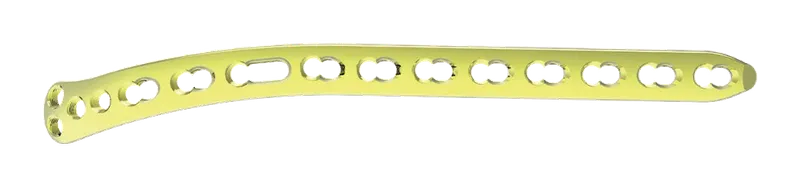
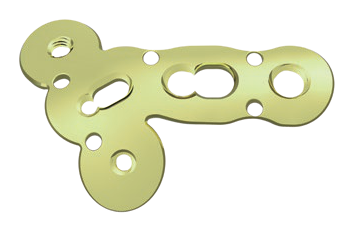
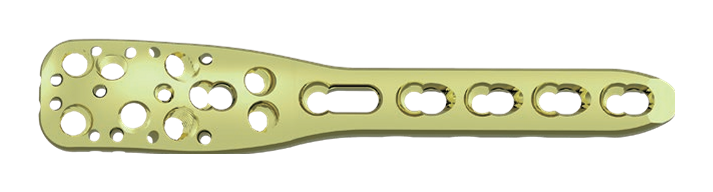
Greater tubercle plates take an asymmetric head of rounded lobes, each lobe a separate area for screw placement; at 42 mm with five holes, left and right, this is the compact option where fixation stays at the tuberosity. The long proximal plate opens into a fan-shaped head, narrows through a curved waist and continues into a shaft of elongated slots — seven lengths from 91 mm to 288 mm, six hole counts: 3, 5, 7, 9, 11 and 13.
Shaft and humeral metaphyseal plates
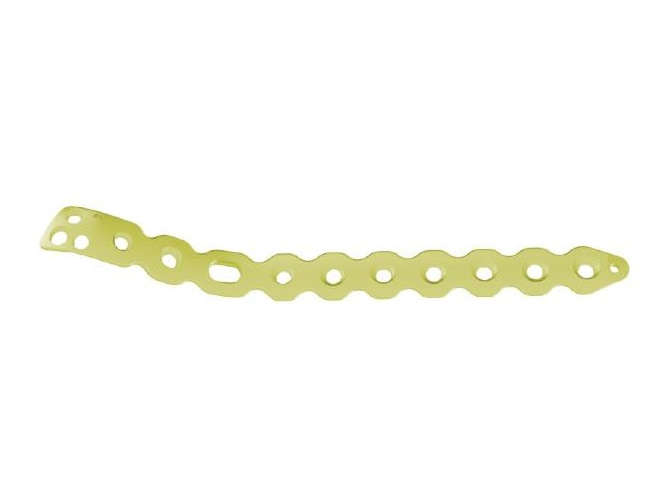
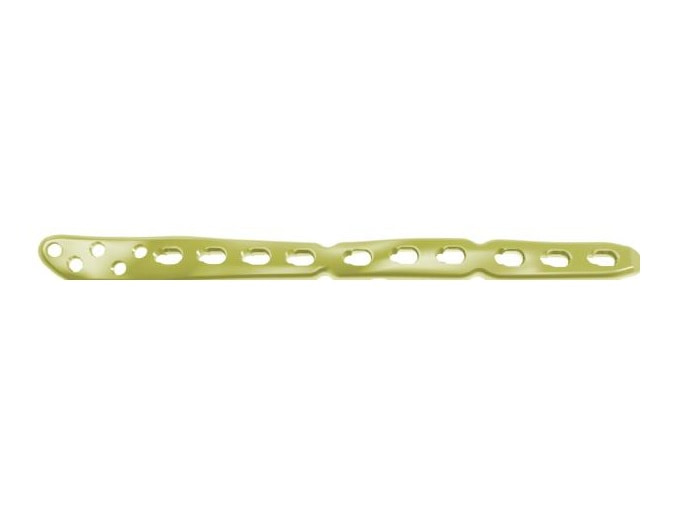
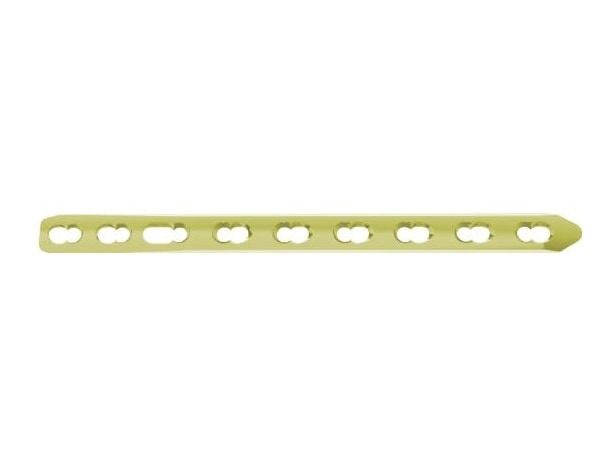
The shaft plate is narrow, with chamfered edges, angled ends and paired-lobed openings down the centre, in twelve variants across seven hole counts: 6, 7, 8, 9, 10, 12, 14. Humeral metaphyseal plates are shallower still, their paired apertures joined by a narrow bridge along the centreline and their ends deliberately unalike — one broad and rounded, one tapered to a facet — so orientation reads at a glance. Four lengths run from 112 mm to 208 mm.
Distal humerus plates in medial, lateral and subcondylar forms
Three plates cover the lower end. The lateral plate is bowed along its length and narrows into a curved end, mixing circular openings distally with elongated slots along the shaft. The medial plate steps from a broad, irregular distal end into a slender shaft. The subcondylar plate carries the longest shaft of the three, in twelve- and fifteen-hole forms at 142 mm and 188 mm. All are machined in-house, OEM and ODM included; request a quote for the size tables.
FAQ
Frequently asked questions
Which regions of the humerus does the range cover?
Seven designs across the whole bone. Two address the proximal end — one focused on the greater tuberosity, one a long plate running from the proximal humerus into the shaft. One covers the metaphysis and one the shaft. Three cover the distal end in lateral, medial and subcondylar forms. Together they account for fifty-one catalogued variants.
How does the greater tuberosity plate differ from the long proximal plate?
The greater tuberosity plate is compact: a single 42 mm length, five holes, left and right, with an asymmetric head of rounded lobes that places screws around the irregular upper contour. The long proximal plate opens into a fan-shaped head and continues into a shaft of elongated slots, in seven lengths to 288 mm, so the fixation extends well below the tuberosity.
Which plates are supplied in left and right forms?
The greater tuberosity plate, the distal lateral plate and the distal subcondylar plate are catalogued only as sided pairs. The distal medial plate is listed in both sided and unsided hole counts. The long proximal plate, the shaft plate and the metaphyseal plate are symmetrical and are chosen by length and hole count alone. An order for a sided plate names the side.
What hole counts do the shaft and metaphyseal plates offer?
The shaft plate covers seven hole counts — 6, 7, 8, 9, 10, 12 and 14 — across twelve variants and twelve lengths between 105 mm and 243 mm. The metaphyseal plate covers four — 7, 9, 11 and 13 — at 112, 144, 176 and 208 mm. Neither is sided, so the same variant serves either arm.
What are the plates made from?
All seven designs are pure titanium, machined at Kangli's works in Suzhou. There is no alloy or polymer component in the plates themselves. Material is the same across every sided form and every length, so a size change within a design does not change what the implant is made of.
Can a plate be made to an OEM partner's drawing?
Yes. Kangli has manufactured orthopaedic implants and instruments since 2002 and runs OEM, ODM and OBM programmes on its own DMG five-axis centres and Swiss-type lathes, with an on-site vacuum furnace for stress relief and annealing. A partner can commission a modified geometry or take a catalogued plate under its own brand.