

Patella Locking Plate Systems
Overview
Range overview
Kangli Orthopaedics builds patella locking plate systems in pure titanium for anterior fixation of the kneecap, alongside a titanium alloy pin for wire-based constructs. Three product families sit on this page: a lattice plate in three footprints, a hooked implant with open curved arms, and a straight pin carrying an integrated eyelet. Between them a construct can be specified as a plate, as a hook around the margins, or as the wire-routing component.
Patellar fracture plates with an open lattice
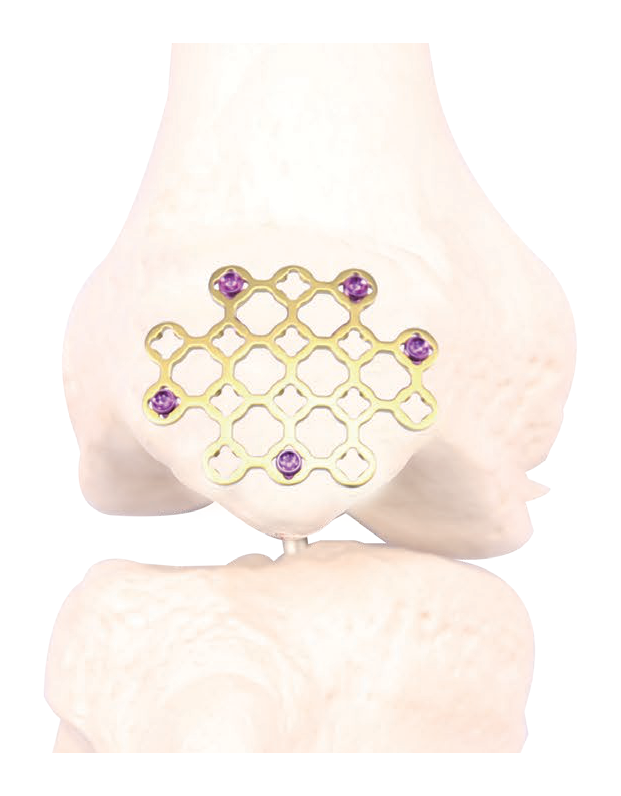
The Patellar Locking Plate replaces a continuous metal sheet with rounded bridges and open windows, leaving parts of the underlying bone exposed between them. Screw interfaces are recessed into the lattice and carry a star-shaped driver pattern, so seated heads stay within the plate profile. Large, middle and small footprints are catalogued, letting the bridge pattern be matched to the patella and the fracture layout rather than to one fixed outline.
Patella hook plates for the kneecap margins
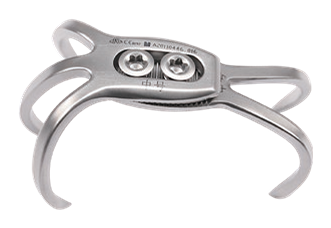
Separate upper and lower arms extend from the compact central body of the Patellar Hook, curving inward toward open tips rather than closing into a loop. Lower arms form the broader, deeper arcs while upper arms follow a shorter and differently angled path, so the implant reaches several areas of the kneecap at once. Four specifications are listed, mid, small, smaller and smaller-II, across eight catalogued variants.
Pins for tension-band wire routing
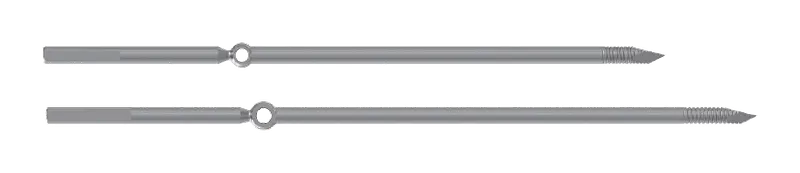
A straight titanium alloy shaft, an integrated eyelet and a tapered point make up the Tension Band Pin. Sixteen variants are catalogued, drawn from two diameters, 2.0 mm and 2.5 mm, and nine lengths between 60 mm and 120 mm, rather than from every pairing of the two. The eyelet is present in every configuration. Kangli has manufactured orthopaedic implants since 2002 and accepts OEM and ODM work; for the patellar section of the catalogue, request a quote.
FAQ
Frequently asked questions
What sizes does the Patellar Locking Plate come in?
Three footprints are catalogued: large, middle and small. Each is machined from pure titanium as a connected lattice of rounded bridges and open windows rather than a solid sheet, with recessed star-drive screw interfaces. Choosing among the three lets the bridge pattern sit against the patella and the fracture layout instead of forcing one fixed plate outline.
How does the Patellar Hook differ from the patellar plate?
The hook is an open component rather than a closed lattice. Separate upper and lower arms curve inward from a compact central body toward open tips, with the lower arms forming broader, deeper arcs than the upper ones. Recessed circular features in the central body carry the middle fixation points. Eight variants are listed in four specifications: mid, small, smaller and smaller-II.
What diameters and lengths does the Tension Band Pin come in?
Sixteen variants are catalogued. The listed diameters are 2.0 mm and 2.5 mm; the listed lengths are 60, 65, 70, 75, 80, 85, 90, 100 and 120 mm, and the sixteen are drawn from those figures rather than from every pairing. Each pin is titanium alloy and combines a straight shaft, a tapered point and a circular eyelet that carries the wire. The eyelet is present in every configuration.
Are the patellar implants made from titanium?
The Patellar Locking Plate and the Patellar Hook are both machined from pure titanium. The Tension Band Pin is titanium alloy. All three are produced in-house on CNC turning and milling centres, with an on-site vacuum heat-treatment furnace used for stress relief and annealing after machining.
Do you take OEM or ODM work on patellar implants?
Yes. Kangli Orthopaedics has manufactured orthopaedic implants and instruments since 2002 and works as an OEM, ODM and OBM manufacturer. R&D covers 3D printing, personalised implants and printed bone models alongside conventional machining. Send the footprint, sizing and material required through Request a Quote and the technical team will respond with what is feasible.